Decide what each person notices and wants before deciding how they phrase a sentence. Different priorities give dialogue somewhere to go. A catchphrase can add flavour, but it has a hard job if everyone underneath sounds alike. We’d start with the reason a character speaks, then work on the rhythm of the line.
Brandon Sanderson’s lecture on customising characters includes an exercise in distinguishing three speakers without dialogue tags. It’s a useful writing check. Our adaptation for games keeps speaker labels in the actual interface: a craft exercise should never become a requirement for understanding who is talking.
How can three characters sound different in the same scene?
Give each person a different immediate concern and a reason to speak. Their attention can distinguish them before you add vocabulary or verbal habits.
Imagine three companions approaching a damaged bridge. These are original examples for this discussion, not dialogue from an existing game or Sanderson’s fiction. They all want to cross safely, but their attention goes to different places.
- The engineer: “The left support is carrying too much.” Their first concern is what might fail.
- The protective companion: “Who’s still on the other side?” Their first concern is who might be left behind.
- The supplies keeper: “How much rope have we got?” Their first concern is what a solution will consume.
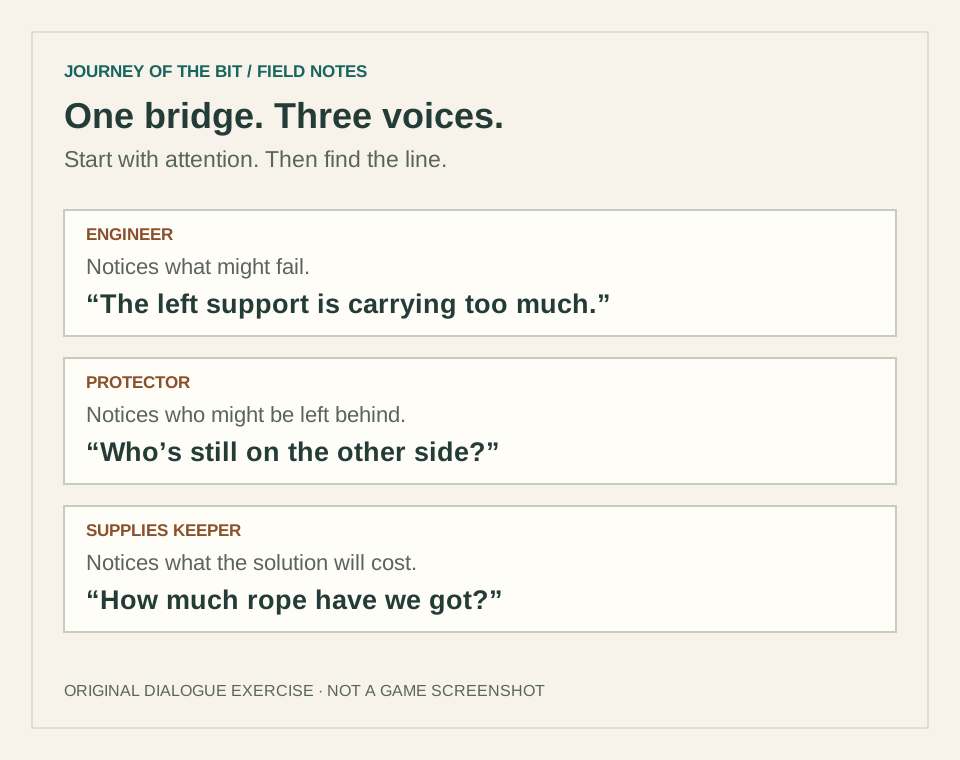
An original dialogue exercise. Each person sees the same obstacle through a different priority; the roles are starting points, not complete personalities.
Notice that nobody needed a funny accent or an elaborate verbal tic. Their lines differ because they are trying to solve different problems. That’s a useful first pass, but it is only a first pass. If the engineer talks exclusively about engineering for an entire campaign, they may start sounding like a walking help menu.
How do I write a character beyond their squad role?
Add a personal attitude towards responsibility, uncertainty and asking for help. A job can shape what someone notices without defining everything they say.
Add a personal attitude to each priority. Perhaps the engineer is careful about making promises: “I can brace this side. I can’t promise the far end.” The protective companion might prefer direct commitments: “I’ll go back for them. Keep this end clear.” The supplies keeper might soften an uncomfortable warning: “We can use the rope here. Just remember we still need to get home.”
These lines suggest different ways of handling responsibility. One qualifies a claim, one volunteers, and one asks others to consider the next problem. You could give those habits to people with entirely different jobs. That is what makes them useful beyond a single scene.
Try separating three choices while revising: what the person notices, what response they want from someone else, and how comfortable they are asking for it. “More sarcastic” is a vague direction. “Warn the group without admitting you’re worried” gives the line a specific task.
How do I keep a character voice consistent across scenes?
Carry the character’s priorities into different situations without repeating the same lines. Changes in behaviour should make sense in context.
Now put the same people around a table after the crossing. The engineer could ask whether anyone heard the brace shift. The protective companion might quietly count the seats. The supplies keeper could coil the remaining rope and say, “Enough for one more bad idea.” A little warmth! They are still recognisable without repeating the earlier lines.
A character should also be able to surprise us. If the normally cautious engineer suddenly says, “It’ll hold. Go,” that departure can carry meaning once caution has been established. Perhaps there is no room for a longer explanation. Perhaps they are taking responsibility for uncertainty. The surrounding scene needs to support whichever reading you intend.
Consistency does not require identical behaviour under every kind of pressure. We’d look for an understandable connection between the familiar pattern and the changed situation. Otherwise the character risks becoming whichever voice the current plot needs.
How do I test character voices across dialogue branches?
Check what the speaker knows in every branch where a line can occur. Keep repeated responses clear and reserve more elaborate character moments for exchanges that can support them.
Game dialogue may be heard out of order, interrupted, skipped or repeated. Imagine the player declines the crossing, then returns later. A line that assumes everyone already crossed would confuse the scene, however beautifully it is written. Check what the speaker can know at that moment as well as how they express it.
Short tactical responses need their own restraint. A repeated movement acknowledgement does not need to carry a character’s whole history. Keep the useful information clear, then let occasional longer exchanges carry more personality. A memorable joke can become much less charming on its twentieth appearance.
If you use AI to propose alternatives, try swapping the speaker names on the draft. Would anything important change? Fluent lines can still be interchangeable. Give the revision a scene purpose and a character priority, then check the result against earlier dialogue. This is our suggested editing method, not a claim about Sanderson’s views on AI.
How do I make distinctive dialogue easy to follow?
Keep speaker labels available and text readable. Voice adds personality, but identifying the speaker should not depend on recognising a writing style or colour.
Distinctive writing should enrich communication. Keep speaker identification available, use readable text, and avoid relying on colour alone to distinguish speakers. The Game Accessibility Guidelines provide further reading on subtitles, captions and clear presentation. Written accents and unusual spellings also deserve care when they make a sentence harder to read.
How can I revise character voices quickly?
Write the same characters in two situations and compare their priorities, requests and phrasing. Check branch knowledge and restore clear speaker identification after any writing exercise.
- Pick three characters and give each a different immediate concern in one shared situation.
- Write one request from each, then rewrite it for a quieter scene.
- Remove the names temporarily and ask what distinguishes the speakers besides vocabulary.
- Check that each line fits what the character knows in every branch where it can play.
- Restore the speaker labels and read the exchange aloud for clarity and unnecessary repetition.
For the underlying relationship, see our note on making players care about a squad character. Voice becomes more interesting when the person speaking has something to care about.
Which game character could you recognise from a single ordinary line? Come talk characters in the studio Discord.