Our bet is on a clear story and characters whose decisions matter. If a tool helps a studio produce more variations, the next question is which ones belong in the game. A strong creative direction gives you a reason to choose.
Imagine two pitches for a tactical game. One promises a huge amount of dialogue. The other describes a rescue specialist who can solve almost any practical problem but struggles to trust anyone else's judgement. Now give that specialist a situation where someone else has the better plan. We'd want to play that scene! There's a person to understand and a conflict to participate in.
This is why Brandon Sanderson's lecture on proactive, relatable and capable characters is useful reading. It treats those qualities as things a writer can vary rather than requiring every character to excel at everything. Our application to games is to ask what that variation lets a player notice, influence, or care about.
For a small studio, we'd start with one relationship and one difficult decision. What does each person want? Why do their preferred solutions differ? What will be different between them afterwards? Build a short, playable situation around those answers before expanding the script. A beautiful biography is only a starting point if the player never encounters the person it describes.
Whether a draft involves AI or a notebook, someone still needs to decide what the scene means and revise the surrounding game to support it. That's our creative position, not a forecast of sales or a claim about Sanderson's views on AI. Good storytelling also needs satisfying play and clear presentation.
If you'd like to explore his fiction, Sanderson's official reading guide points to books including Mistborn and The Way of Kings. No plot revelations needed here: we're interested in the craft questions you can bring back to games.
How do I turn a story promise into a playable idea?
Describe an experience the player can actually have. Use that promise to choose scenes, decisions and consequences that support the same direction.
For us, ‘strong story’ needs to become something more specific before it can guide production. Try writing one sentence about an experience the player can actually have: ‘You lead capable people who disagree about what a good outcome costs.’ That sentence suggests scenes, choices and relationships. ‘An epic world with unforgettable characters’ mostly gives you adjectives.
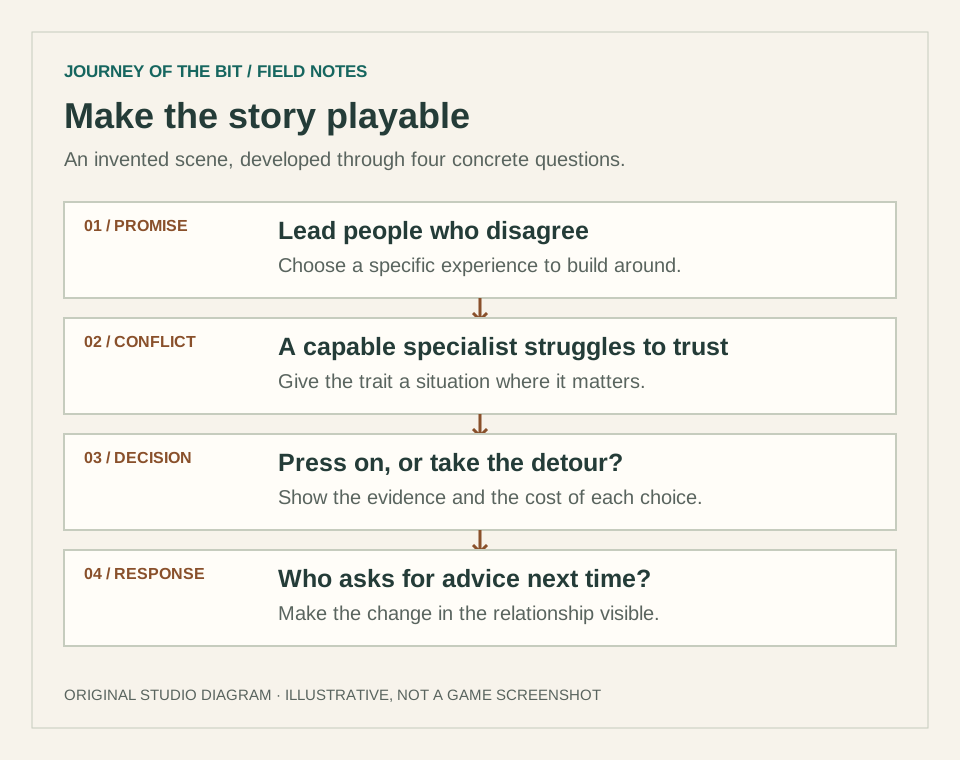
An original planning exercise: move from a story promise to a consequence the player can recognise.
The distinction is useful when tools make it easy to generate alternatives. Ten character biographies are ten proposals to evaluate. They are not ten relationships the player has experienced. We’d choose the proposal that produces a clear playable situation, then spend the next round of work making that situation legible and responsive.
How do I turn a character trait into a playable scene?
Put the trait under pressure in a decision the player can influence. Show understandable reasons for the competing options and a later response to the choice.
Take the hypothetical rescue specialist from above. Their capability gets the team to a damaged crossing. Their reluctance to trust others becomes relevant when a less experienced colleague notices that the proposed route is unsafe. The specialist wants to press on; the colleague asks for a detour. Now the trait has somewhere to go.
Before asking the player to decide, show evidence for both concerns. Perhaps the crossing is visibly damaged and the detour consumes scarce supplies. Do not hide all the useful information and then scold the player for guessing wrong. The decision should express a priority the player understands, even if its full consequences are uncertain.
A later exchange can carry the result. The specialist might ask for the colleague’s assessment before proposing the next route. That small change could communicate growing trust without a speech announcing character growth. This is an invented design exercise to explore how a character trait can shape play.
How can creative constraints give a game a distinctive identity?
Choose a few rules for the experience and apply them consistently during revision. Dialogue, pacing, visuals and sound should reinforce those rules.
A small studio cannot polish every possible version of a game. We’d pick a few creative rules and use them while revising: characters disagree for understandable reasons; dialogue points to something happening in play; consequences return in a form the player can recognise. A scene that breaks those rules needs a reason to stay.
Visual and audio choices can reinforce the same direction. If a scene depends on noticing hesitation, the presentation needs room for it. If an urgent decision is interrupted by five paragraphs of explanation, the pacing may fight the intended feeling. Story is shaped by what players do, see and hear together, not only by the script file.
How can I test a story idea before expanding the script?
Sketch one choice and a visible consequence, then ask someone what the characters wanted. Revise what the scene fails to communicate before adding more encounters.
- Build or sketch one encounter with a choice and a visible response. Use temporary art if that helps you finish the example.
- Ask someone what each character wanted, without explaining your intended answer first.
- Ask which choice they made and why. Look for reasons grounded in the scene rather than a guess about what the writer wanted.
- Revise the missing evidence or unclear response before multiplying the number of encounters.
These are suggested questions for a future test, not results we’re claiming to have collected. A clear answer would show that this particular scene communicates; it would not prove commercial demand. Standing out still requires getting the game in front of people and giving them a satisfying reason to stay.
The next note develops this into a specific character exercise: making players care about a squad member.
What makes you remember a game after its screenshots have faded from memory? Follow the studio journal for more on story, characters and game development.