Give the player a chance to see what the character values when acting on it costs something. A portrait and a backstory can introduce someone. A difficult choice gives those details a job to do.
Here's an invented scene for this discussion. A squad member wants to recover a colleague's equipment. Another wants to use the remaining supplies to get everyone home. Neither needs to be cruel or foolish. They disagree about what taking care of the team means. The player has a practical decision, and the disagreement gives it emotional weight.
Brandon Sanderson's character identity lecture connects motivation, personality and values. That distinction helps us ask why two people with the same broad goal might behave differently. We're applying his writing framework to a hypothetical game encounter.
The encounter needs consequences the player can recognise. Perhaps the person whose request you rejected still helps, but stops asking you for favours. Perhaps the recovery succeeds and the next conversation reveals who bore its cost. A smaller, specific response can carry more meaning than an unexplained relationship score changing in a menu.
There's also a player-agency problem to solve. If the character always overrides your commands to demonstrate their personality, attachment can turn into irritation. We'd rather establish the disagreement, let the player make an informed choice, and write a response that fits. The exact arrangement depends on what kind of game you're making.
Sanderson's Second Law essay discusses how constraints can make fictional powers more interesting. Our parallel for game design is that a character becomes more specific when helping them requires giving something else up.
When considering AI-assisted character drafts, this is the test we'd apply: which detail actually changes a scene? Keep developing that detail instead of just adding another paragraph to the biography.
How do I make both sides of a character disagreement believable?
Give each character an understandable value and a defensible action. A shared concern can still lead to different views about what the team should do.
Let’s stay with the invented equipment-recovery scene. One squad member believes bringing the kit back is a promise to a colleague. Another sees a dwindling supply reserve and believes protecting the living team comes first. Both care about people. Their disagreement becomes interesting because the same broad value leads them towards different actions.
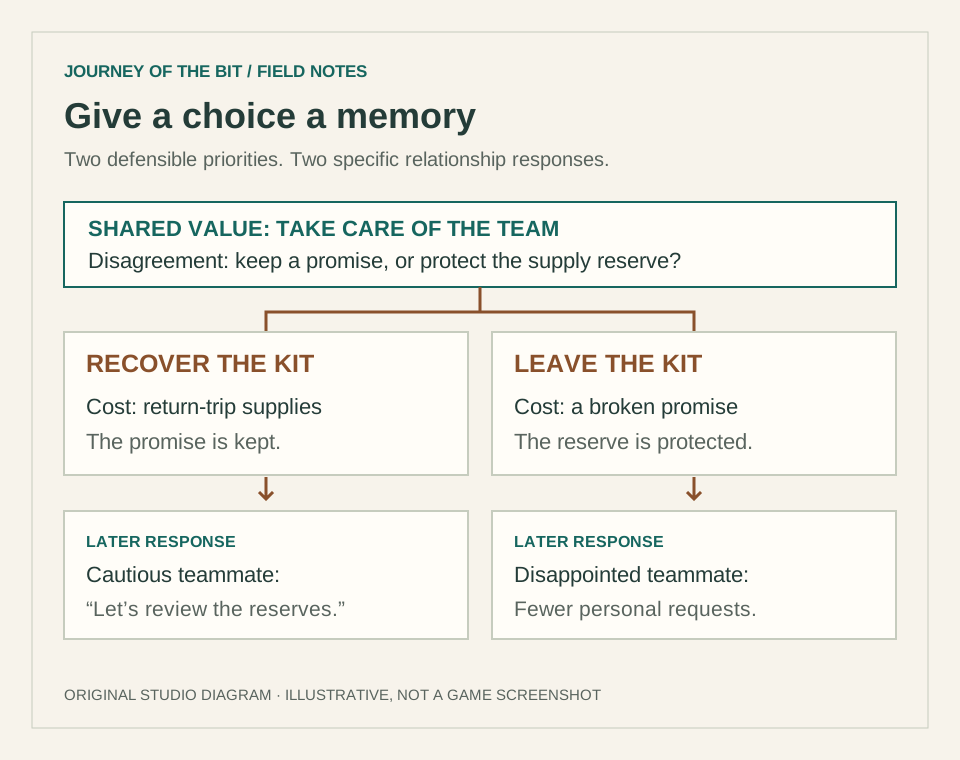
An invented character encounter for this discussion. Neither branch is labelled the correct answer.
The equipment also needs meaning in the scene. Perhaps it contains work the colleague hoped to finish, or an ordinary object someone agreed to return. We would choose one detail and make it visible before the decision. Adding three pages of history afterwards asks the player to care retroactively about evidence they never had.
How do I show the cost of a character choice?
Make the immediate tradeoff understandable before asking for commitment. The player needs enough evidence to express a priority rather than guess what the writer expects.
A useful choice needs understandable stakes. In this hypothetical encounter, recovering the equipment uses supplies reserved for the return trip. Leaving it protects that reserve but breaks a promise. Tell the player that much. You can leave room for uncertainty without concealing the basic bargain.
Avoid making one option secretly generous and the other pointlessly cruel. If leaving is always punished and recovering always produces a reward, players may learn to search for the approved answer instead of considering the characters. Both branches should acknowledge the reason someone might choose them. That doesn’t require equal rewards or an ending where everyone is pleased.
How should a relationship respond to player choices?
Show a specific change in what a character says or does. Ground that response in the actual choice instead of relying only on an unexplained relationship score.
If the player recovers the kit, the person who argued for caution might still help carry it. Later, they could ask to review supply plans before the next departure. If the player leaves it, the person who made the promise could remain reliable in the field while becoming less willing to make personal requests. These responses preserve the squad’s ability to function while giving the disagreement a memory.
We like those possibilities because they point back to what happened. Compare ‘relationship minus five’ with ‘they now insist on checking the reserve themselves’. A score may be useful feedback, but the behaviour explains what changed. The two can coexist; the number does not have to do all the storytelling.
Why do squad characters need ordinary moments?
Quiet interactions can establish what a character is like outside a crisis. Those details give later changes in behaviour something familiar to build on.
Not every conversation should be a crisis! A character can reveal the same value by checking another person’s gear, keeping an inconvenient promise, or asking a practical question nobody else thought to ask. Small actions give the player a pattern to recognise. A later difficult choice then tests something already established.
Leave room for the player to feel differently from the writer. Someone may appreciate the cautious squad member more than the idealistic one. Someone else may care mainly because either has been dependable during missions. The aim is to make the people understandable, not to require one approved emotional response.
How can I review a squad-character draft?
Check what the character wants, what pursuing it costs and what the player can influence. Then trace a visible response that fits the decision.
- Write what the character wants in this scene in one sentence.
- Give another character a conflicting request with an understandable reason.
- Name the cost the player can see before deciding.
- Write one specific response for each choice, without calling the player good or bad.
- Add a later, quieter moment that lets the player recognise the relationship has changed.
Then remove the biography and read the scene again. Can you still tell what each person values? If not, put that information into an action, a concrete request or a visible consequence. This is also a useful editing test for AI-assisted drafts: a distinctive adjective earns its place when it affects something the player can encounter.
Which squad member’s choices stayed with you? Follow the studio journal for more on characters, tactical games and the decisions behind them.