Show the player what matters early, let their experience develop it, and make the eventual resolution answer that expectation. A dramatic final scene has more to work with when the player has already invested in the problem. The useful question is not just “Is this ending exciting?” It is “What did the player experience that makes this ending matter?”
Brandon Sanderson’s plot lecture on promise, progress and payoff connects the expectations a story establishes with meaningful advancement and resolution. The linked notes contain spoilers for other fiction. Our example here is entirely invented; the application to player choice is our interpretation of the framework.
How do I establish a story promise in a game?
Introduce a question the player has reason to care about through a practical choice. Make clear what is at stake without promising a particular ending.
Imagine a tactical adventure about two colleagues who disagree on how to protect their team. Mara wants to gather everyone before moving. Ellis thinks waiting in an exposed position puts everyone at greater risk. Neither needs to be foolish. They have competing ideas of responsibility, and the player has to decide how to proceed.
An early encounter can establish that disagreement through a small practical choice. Wait for a straggler and spend scarce supplies, or send someone back while the rest reach shelter? Let the player understand the tradeoff before choosing. A conversation afterwards can acknowledge whose concern they took seriously.
The promise is a question: can these people learn to rely on each other when their instincts conflict? It does not guarantee a happy reconciliation. It tells the player that this relationship deserves attention and that later events will do something with it.
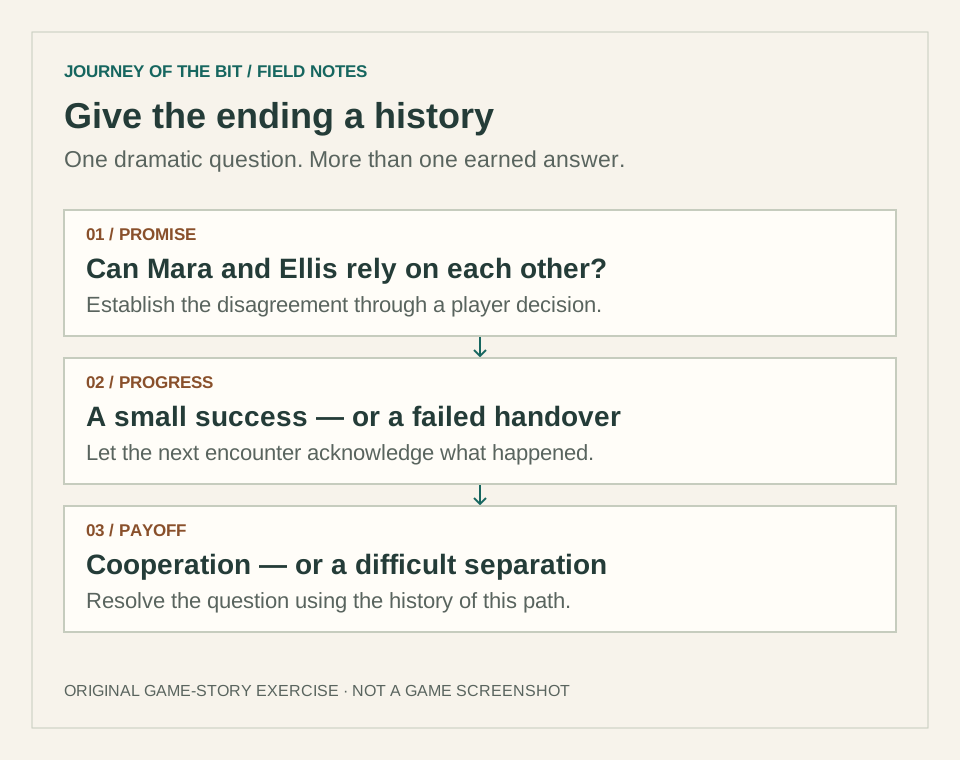
An original story-planning diagram. Different outcomes can answer the same dramatic question; the path needs to support the answer.
How do I show meaningful story progress?
Change something the player can recognise in a relationship or problem. A repeated argument only advances the story if it adds understanding or alters what happens next.
A second argument with louder voices is not necessarily progress. We’d ask what is different after the next encounter. Does Mara give Ellis a responsibility she previously kept for herself? Does Ellis wait for a signal instead of making an independent decision? A small action can show movement more clearly than another speech about trust.
Suppose the player asks Ellis to prepare a safe route while Mara gathers the team. On one path, both keep their commitments. On another, the player changes the plan without making the new handover clear, and the coordination fails. The next scene should acknowledge the actual event. Friendly dialogue that ignores a failed handover would make the relationship feel disconnected from play.
Progress can also mean discovering why cooperation is difficult. Perhaps one colleague understands the other’s concern but still cannot accept the cost. That gives the player new information without requiring every encounter to move a friendship score upwards. Trouble can develop an arc too!
How do I make a story payoff follow from player choices?
Resolve the established question through actions supported by this player’s experience. Different paths can reach different emotional outcomes without abandoning the original promise.
For a cooperative resolution, imagine a final evacuation where one colleague must organise the group while the other prepares the exit. Their willingness to depend on each other now has a history. The player recognises a familiar problem, but the relationship lets them approach it differently.
The resolution could instead be a deliberate separation of responsibilities, or a painful refusal to cooperate. An earned payoff need not be cheerful. It should follow from what this player has seen and chosen. If the story has repeatedly shown broken commitments, a sudden declaration of complete trust needs more support than triumphant music.
We would also leave a little space after the decisive action. A practical exchange about what happens next can reveal what changed. The emotional resolution does not always need to be the loudest moment in the scene.
How do I make an ending work when players skip optional content?
Keep essential context on every route that requires it. Optional scenes can deepen a resolution, but the ending should still make sense without them.
A game cannot always assume that every player saw the same conversation. Mark which events establish essential context and which add texture. An optional discussion might explain why Mara dislikes splitting the group, but the main route still needs to show that she objects and what is at stake.
Try reading an ending with every optional scene removed. Can you explain the outcome using only events that remain? If not, either move essential information onto that route, provide another way to encounter it, or change what the ending claims. Optional content can make a resolution richer without carrying its entire explanation.
For branching stories, write a short evidence list for each ending: what the player chose, what the characters witnessed, and which relationship changes followed. A single shared final scene may still work, but its dialogue and actions should not refer to a history that never happened on that path.
How do I decide whether a scene belongs in the story?
Ask what the scene changes in the player’s understanding. Shorten or combine material that merely repeats an established point.
Whether a scene starts in a notebook or as an AI-assisted draft, ask what it changes in the player’s understanding. It might establish a concern, test an agreement, or reveal a consequence. If it only repeats an existing point, consider shortening or combining it before adding more dialogue.
This is an editing lens, not a production result or a guarantee of an audience. Sanderson’s official reading guide offers entry points into his fiction if you want to explore longer stories alongside the craft discussion. The game examples and AI-era observations here are ours.
How can I check whether a game ending feels earned?
Trace the opening question through meaningful developments to the final action. Check that each route supplies the evidence its ending relies on.
| Story stage | Question to answer | Evidence the player can encounter |
|---|---|---|
| Promise | What should I care about? | A practical choice that introduces a relationship or problem |
| Progress | What has changed? | A kept commitment, failed handover or new understanding |
| Payoff | How is the opening question answered? | An action supported by events on this player's route |
- State the question the opening asks in one sentence.
- Identify two moments that change the player’s understanding of that question.
- Describe how the ending answers it through something a character does.
- Check every route to that ending for the context it needs.
- Remove one scene and ask what becomes less understandable. If nothing does, reconsider its purpose.
For the people inside that structure, our notes on squad relationships and distinctive character voices offer companion exercises.
What makes a game ending feel earned to you? Join the studio Discord and talk stories with us. Please label spoilers when discussing particular endings.