Both limit what a unit can do during a turn. In common usage, time units divide that budget into many small costs, while an action-point system may use fewer, larger chunks. The names aren't a universal standard, though. You need to look at the actual rules.
Imagine a made-up game where a soldier starts with 40 points. Moving one tile costs four and firing costs 16. Move three tiles and fire once, and you've spent 28. You can decide what the remaining 12 are worth. That is a fine-grained budget: small changes in position can change your options.
Now imagine a different game with two actions. A move costs one, and an attack costs one. The arithmetic is simpler, but the interesting question moves elsewhere. How far does one move reach? Does attacking end the turn? Are there exceptions for particular abilities? Those details matter more than whether the interface displays two points or forty.
We don't think a bigger number automatically makes a better tactical game. Fine-grained costs can reward precise planning, while larger actions can make the shape of a turn easier to understand. Either can become fiddly if the game keeps asking you to calculate something that rarely changes your decision.
When comparing games, check movement, firing, reloading and any reaction rules separately. Don't assume one familiar term tells you how all four work. OpenXcom's project documentation and 2K's XCOM 2 FAQ are useful starting places for investigating those particular games; our numbers above are invented examples, not their rules.
How does a time-unit turn work?
Add the cost of every planned action, including the move back and any reload. In this invented 40-point system, small position changes can determine whether a complete plan fits.
Let’s make the invented 40-point example precise. Each tile costs four points, a shot costs 16, and reloading costs eight. Actions do not end the turn automatically. Unspent points expire; there is no reaction-fire rule in this example. Those assumptions matter, because changing just one could change the best plan.
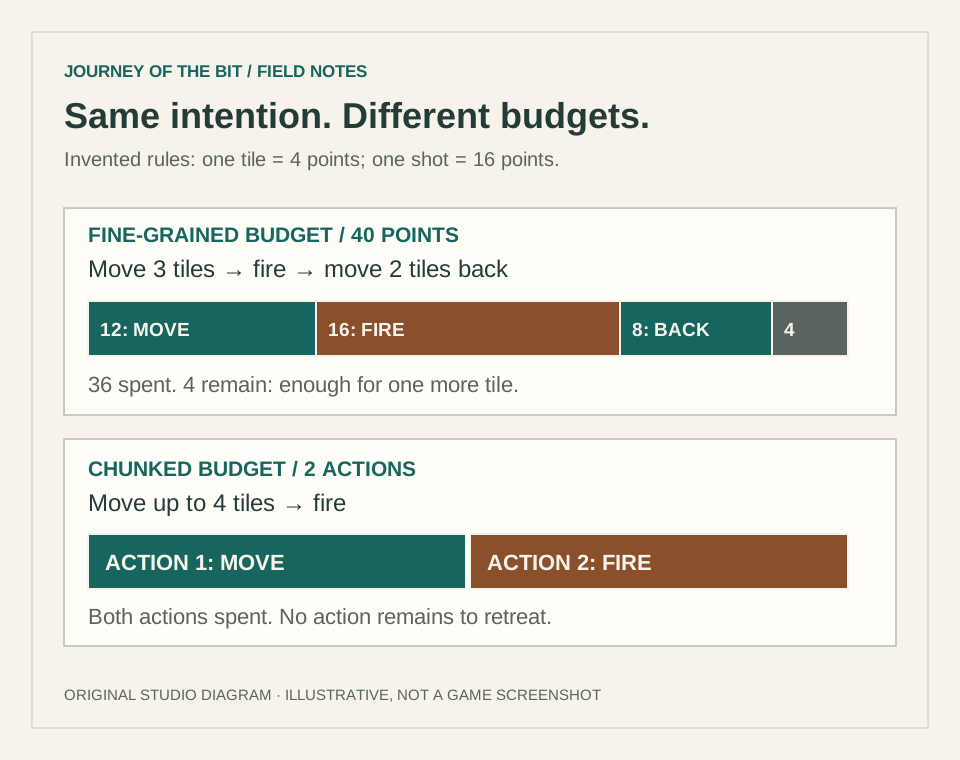
Invented rules for this explanation, not the rules of X-COM. The full costs and assumptions are explained below.
Plan A is to move three tiles, fire, and move two tiles back: 12 + 16 + 8 = 36. Four points remain, enough for one more tile. Plan B is to stay still, fire twice, and reload: 16 + 16 + 8 = 40. Both plans fit the budget. Whether either is sensible depends on the map, ammunition and the objective.
Now suppose a better firing position is four tiles away instead of three. Moving there, firing, and returning four tiles would cost 16 + 16 + 16 = 48. It doesn’t fit. You could still reach the position and shoot, but you would have only eight points left for movement. That single-tile difference changes where you can finish. This is the kind of small spatial tradeoff a granular budget can create.
How does a two-action turn change the plan?
In the invented two-action system below, a move and a shot leave no action for retreat. That changes the available sequence without establishing that one system is deeper than the other.
For our second invented system, give a unit two actions. One move reaches up to four tiles, one shot takes one action, and neither automatically ends the turn. There are no free actions. Moving three tiles and firing uses both actions, so the retreat from Plan A is unavailable. Shooting twice also uses both actions, leaving no reload.
That does not mean the second game offers less to think about. If another unit can cover the destination, or the objective rewards holding it, choosing where to spend the move can still be difficult. The turn budget is one part of a larger design. Terrain, information, squad roles and consequences supply the reasons to choose.
Which action-budget rules should I check?
Check turn-ending attacks, movement pricing, equipment costs and reaction rules. The displayed number alone does not explain how these systems interact.
| Plan under the invented rules | 40-point budget | Two-action budget |
|---|---|---|
| Move three tiles and fire | 28 spent; 12 remain | Both actions spent |
| Move three tiles, fire, retreat two tiles | 36 spent; 4 remain | Needs a third action; unavailable |
| Fire twice and reload | 40 spent; none remain | Needs a third action; unavailable |
- Does an attack end the turn even when points remain? Check the action’s rule, not just its displayed cost.
- Does movement charge per tile, per distance band, or per action? Check whether terrain changes that cost.
- Do reloading and equipment changes share the movement budget? A reload may compete with reaching safety.
- How do reactions work? Some systems require a specific stance or resource reservation; never assume unused points automatically protect you.
Names can overlap. A game may call a large, finely divided pool ‘action points’, or mix a movement allowance with separate attacks. Read the action previews and rule descriptions together. The useful distinction is how the budget behaves, not which abbreviation appears beside the unit portrait.
What makes an action budget easy to use?
A useful preview shows the cost, the remaining budget and the actions still available afterwards. This lets players evaluate a plan before committing.
We’d look for previews that answer three questions before a click: what will this cost, what will remain, and which useful actions will still be possible? Showing a reachable tile is helpful; showing whether you can still fire from it is better. Predictable costs let the player concentrate on the plan instead of repeatedly correcting arithmetic.
Try describing a favourite turn without mentioning its numbers. ‘I drew attention with one unit so another could cross’ tells us why it was satisfying. ‘I used all forty points’ tells us only that the budget was spent. Efficient spending can feel good, but the interesting bit is what it achieved.
Do you enjoy counting out a precise turn, or seeing a few clear choices? Follow the studio journal for more thoughts on tactical games and game development.