Absolutely. Depth can come from how squad members depend on each other, rather than how many portraits fit along the bottom of the screen. A small team can create difficult decisions when several useful jobs compete for the same people. The interesting question is which risk you choose to leave uncovered.
That does not make small squads automatically better. A larger team can support plans that need several simultaneous actions, broader formations or reserves. We’d judge the encounter by the decisions it creates, not count the units and declare a winner.
How can three units create several useful plans?
Give the squad more worthwhile jobs than it can complete at once. In this invented encounter, three units must choose which of four jobs to leave undone.
Imagine an invented encounter in a room with two entrances and a terminal in the centre. You have three units. For this example, each can complete one job this turn: watch an entrance, operate the terminal, or keep the exit route clear. Each entrance needs its own watcher. Operating the terminal advances the objective but gives that unit no spare action to cover anything else.
There are four useful jobs and only three people. You could watch both entrances and operate the terminal, leaving the exit route unattended. Or cover one entrance, operate the terminal and protect the exit. You could also postpone the terminal and secure the room first. That last option is only interesting if delay has a cost you understand, such as giving an opposing patrol another opportunity to approach.
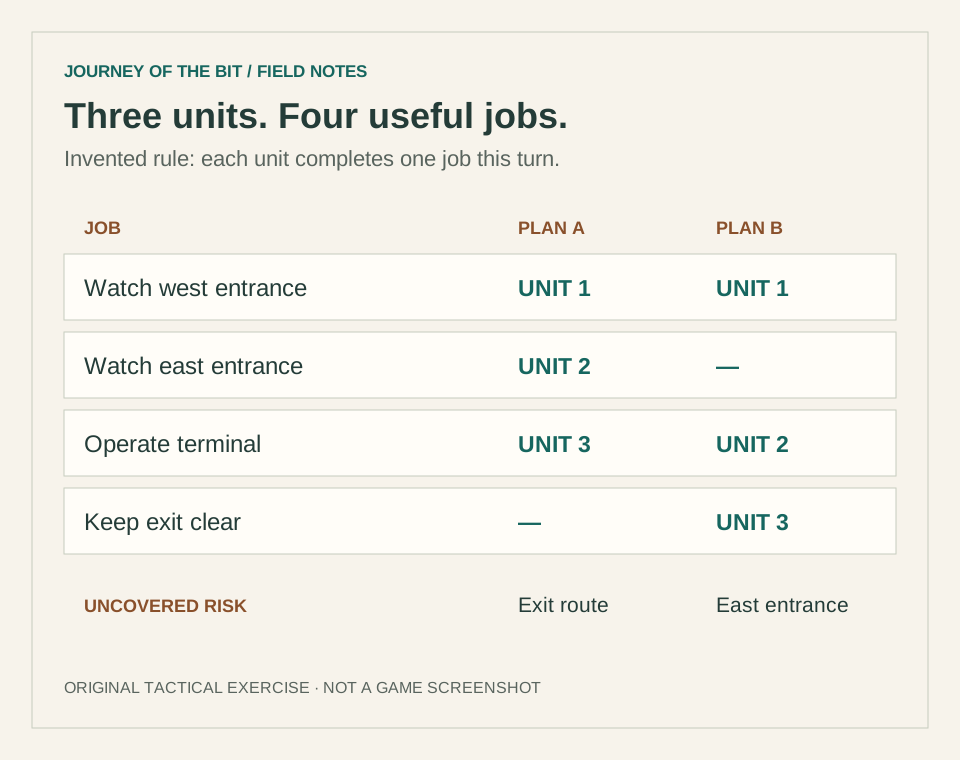
An original planning diagram, not a game screenshot. The simplified rule is one job per unit this turn; neither illustrated plan is always the best choice.
How do I make an uncovered tactical job matter?
Give the alternatives different, understandable costs. A task that is never useful or always compulsory offers little room for a meaningful choice.
Scarcity alone does not produce a satisfying decision. If the east entrance is never used, leaving it unguarded becomes an obvious answer. If the exit is essential immediately, protecting it may be compulsory. The alternatives need different, understandable costs, not merely different labels.
Perhaps you have evidence of movement near the east entrance, but the exit is currently clear. Watching east now looks sensible. On a later turn, someone needs to carry equipment out, changing the value of the exit route. The same three units can face a different problem without acquiring six new abilities.
Give the player enough information to reason about those changes. An uncertain threat can create tension; a completely hidden rule that punishes the apparently sensible plan can feel arbitrary. We like being able to explain a decision afterwards: “I covered that entrance because of what I knew, and accepted the risk at the exit.” Even a failed plan can make sense.
How can squad members change each other’s options?
Let one action create an opportunity for another unit, with a cost or competing use. That connection asks the player to assemble a plan across the team.
Now introduce one hypothetical support action. A unit can prepare the terminal so a colleague needs less effort to use it on the following turn. That spends an action today to create flexibility tomorrow. Whether it helps depends on whether the squad can afford to wait and whether the colleague will still be able to reach the terminal.
The important part is the connection between actions. Compare three units independently taking their best available shot with one unit helping another reach a useful position while a third covers the move. Both can be enjoyable, but the second asks the player to assemble a plan across the team.
Be careful with combinations that always dominate. If preparation is free, safe and useful in every encounter, it may become a routine extra click. A cost, limitation or competing opportunity gives the player a reason to consider when to use it. More steps do not necessarily mean more thought.
For a closer look at how action costs shape those choices, our time units and action points guide works through two invented turn budgets.
What happens when a fourth unit joins a small squad?
An extra unit can cover a missing job or create new decisions about reserves and positioning. Whether it adds depth depends on the encounter, not just the roster size.
Under the room’s original rules, a fourth unit could cover the missing job. That might make the encounter easier. It might also give a struggling player welcome breathing room, or let the encounter introduce a new decision elsewhere. Removing a tradeoff is not automatically a design mistake.
A larger squad can add decisions about spacing, reserves and which members commit first. It can also leave players repeating similar actions with little change in the plan. The useful test is whether the extra person creates a new relationship between decisions, absorbs a meaningful risk, or mainly increases the time spent issuing orders.
Try replaying the paper exercise with two, three and four units. Note which alternatives disappear and which become possible. This is a suggested design exercise, not a claim about completed playtests or a particular game’s balance.
How can a small squad recover from a setback?
Leave understandable alternatives when a unit cannot perform its usual job. Some shared competence can preserve options while specialists retain distinctive strengths.
With fewer units, losing access to one can remove a large part of the team’s capacity. A small squad needs thought about setbacks as well as perfect plans. Can another member take over an essential job? Can the objective be delayed? Is retreat understandable and possible under the rules?
Some overlap between roles can help. A specialist might be the most efficient choice without being the only person allowed to interact with an objective. Too much overlap, however, can make the roster feel interchangeable. We’d look for distinctive strengths alongside enough shared competence that one problem does not erase every reasonable plan.
How can I recognise tactical depth in gameplay footage?
Watch which actions enable teammates, which useful tasks remain undone and how the player responds to mistakes. Those relationships reveal more than counting available units.
For neighbouring approaches, explore the official material for Invisible, Inc., which foregrounds stealth and teamwork, and Pathway, which describes squad combat involving cover, positioning and character abilities. These are starting points for observation, not claims that either uses the invented rules above.
When watching an ordinary turn, ask:
- Which action makes another squad member’s next move possible?
- What worthwhile task remains undone, and why?
- Would one extra unit introduce a new plan or simply complete the existing one?
- After a mistake, can the player revise the plan in an understandable way?
Those questions tell us more about tactical depth than the size of the roster. What is the smallest team that has given you a really interesting turn? Join the studio Discord and share your favourite example.