Yes. A tactical game can create tension through scarce resources, competing objectives and decisions whose consequences are difficult to undo. A countdown adds pressure to act sooner, but a choice can matter even when you have unlimited time to think about it.
There is a particular kind of hesitation we enjoy discussing: you understand the options, neither gives you everything, and the next click makes the tradeoff real. You can put the kettle on before choosing. The problem will still be waiting when you get back.
That is different from a game demanding a quick response. Separating those experiences helps explain why someone might enjoy tense battles while disliking timers.
What is the difference between thinking time and a turn limit?
Thinking time is the real time available to consider an action. A turn limit restricts how many rounds or actions the mission allows, even if each individual decision can take as long as you like.
A third kind of pressure operates across a campaign: choosing one opportunity may spend resources or advance events elsewhere. These mechanisms can coexist, but they ask different things of the player. “I don't like timers” is a useful starting point for a conversation, not a complete description of someone's preferences.
| Source of pressure | What it restricts | Question to ask |
|---|---|---|
| Real-time deadline | Seconds available to respond | Can I pause or take longer to decide? |
| Mission turn limit | Turns available to complete an objective | Can I think freely between actions? |
| Resource commitment | What remains for later problems | What do I give up by spending this now? |
| Competing objectives | Which outcomes can be secured together | What worthwhile task must I leave undone? |
Removing a real-time deadline need not remove the consequences of an action. Likewise, removing a mission turn limit does not automatically make an encounter easy.
How can one scarce resource create tension without a timer?
A scarce resource creates a meaningful choice when spending it helps one goal but prevents another worthwhile use. The alternatives need understandable costs, rather than a hidden punishment for choosing incorrectly.
Imagine a hypothetical squad encounter with two optional recovery rooms and a safe exit. Each room contains one supply crate. A blocked passage into each room can be opened in one of two ways: use the squad's single cutting charge and preserve the crate, or pull a remote clearance lever that opens the passage but destroys that room's crate.
For this example, the lever is safe to use, the charge cannot be replenished, and opened passages stay open. There are no enemies, mission deadlines or events triggered by waiting. Both routes and their consequences are known. The squad can leave safely at any point.
The west room holds medical supplies; the east holds replacement equipment. The optional objective is to recover useful supplies, but the rules allow only one crate to be recovered intact. Use the charge in the west and the medical crate is preserved. Use it in the east and the equipment crate survives instead. Opening the other passage with its lever cannot recover the destroyed crate.
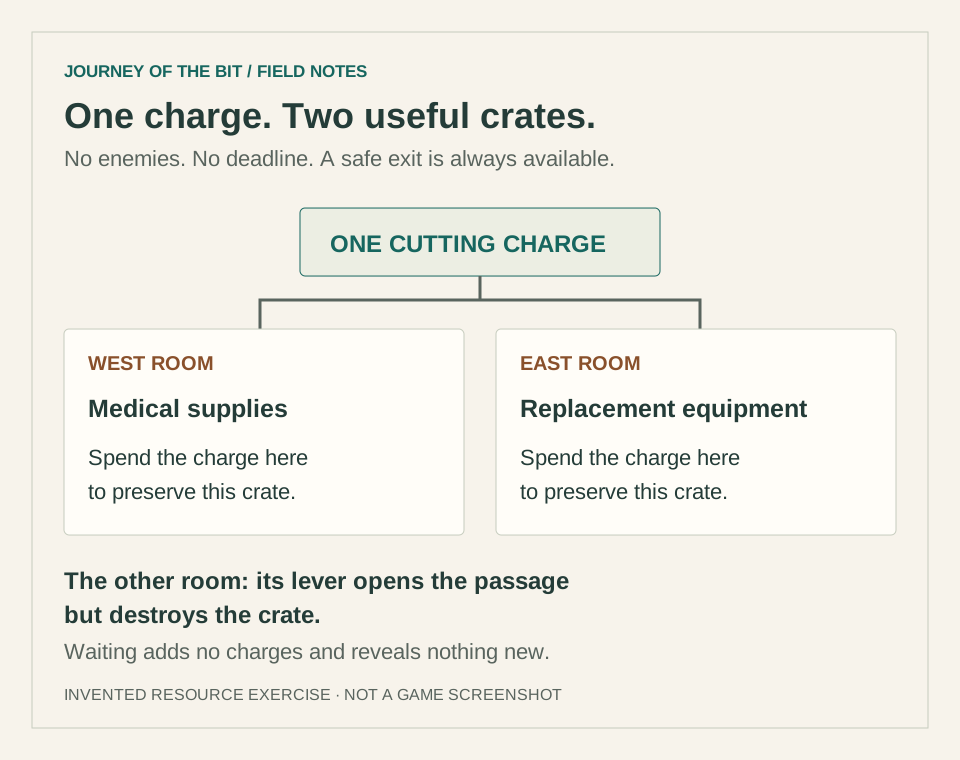
These are invented rules for a design exercise. The diagram shows a resource tradeoff, not a game screenshot or a reported playtest.
The choice has stakes if the player cares about both possible rewards. If one crate is useless to this squad, the same encounter becomes straightforward. Scarcity supplies a constraint; the wider context gives that constraint meaning.
Does uncertainty make a tactical choice more tense?
Uncertainty can add tension when the player understands what is unknown and can reason about the risk. It is not required: the fully explained resource choice above can still produce a difficult commitment.
As a separate variant, imagine that the crate labels are missing. Now choosing a room also means accepting uncertainty about its reward. That might suit an exploration-focused encounter, but it weakens the original exercise about choosing between known needs.
We would ask what the uncertainty contributes before adding it. Is the player weighing a risk, or simply guessing because the interface withheld something the character should know? Our fog-of-war guide explores how to distinguish current observations from remembered information. Clear information rules let uncertainty become part of a plan.
What prevents waiting from becoming the best action forever?
Waiting needs examination when it continually improves the position without a competing cost. In the invented recovery encounter, waiting changes nothing, so it neither solves the tradeoff nor needs a punishment.
There is no requirement to force the player onward just because they are considering the choice. They can compare their priorities and act when ready. The encounter still ends only when they commit or leave.
A different hypothetical system might restore the cutting charge whenever the squad waits. That would remove the original scarcity: preserve one crate, wait, then preserve the other. If preserving both is not the intended decision, reconsider the regeneration rule before adding a countdown to compensate for it.
Our small-squad exercise considers another form of scarcity: more useful jobs than available people. In both cases, inspect what the rules make possible rather than assuming a visible timer is the only source of pressure.
How can a game preserve tension while allowing more thinking time?
Keep the consequences of decisions understandable while giving players time to read, inspect and plan. Timing demands and strategic difficulty can be considered separately, even though changing either may affect the experience.
The Game Accessibility Guidelines recommend allowing players to advance text at their own pace and offering alternatives to essential precise timing, including actions available while paused. Applying those principles to tactical decision-making is our design interpretation, not evidence that a particular adjustment suits every game.
For a contrasting point of reference, Klei's official Invisible, Inc. overview foregrounds stealth, precision and teamwork. It is a starting place to investigate how a game presents high-stakes decisions, not evidence that it lacks timers. Check a game's actual mission rules, modes and settings before recommending it to someone who dislikes a particular kind of pressure.
What should I check when judging tension without a countdown?
Identify what the player values and what committing will change. Then ask whether the competing options remain meaningful under the actual rules.
- Does each option preserve something worth caring about?
- Are the immediate costs explained before commitment?
- Does waiting improve the situation, change nothing or carry a cost?
- Can a repeatable action erase the intended tradeoff?
- Is the tension coming from a difficult decision or from difficulty understanding it?
A countdown can be an effective tool. It is simply one tool among several for making a tactical decision feel consequential.
Join the studio conversation on Discord to discuss the kinds of tactical pressure you enjoy, and the ones you would happily switch off.