Scout a doorway when the information can change your next decision and you have a workable response to what you discover. Keep the squad within supporting reach when sending someone ahead would leave them stranded. The useful question is what happens after the scout sees trouble.
That little patch of floor beside a door can carry an absurd amount of tension. One step might reveal an empty room. It might also reveal exactly why you should have saved someone else's turn. We love tactical decisions that make a small movement feel consequential.
There is no universal doorway trick across squad games. Movement costs, enemy activation, reaction attacks and visibility rules all change the answer. Here is an invented exercise that makes those assumptions explicit.
When is scouting a doorway worth the action points?
Scouting is useful when the information can change available actions and the scout has a workable response. In the invented example below, the movement budget includes a return trip.
Imagine three units in a corridor, with an open doorway ahead. Their objective is to find a clear route through the room while keeping everyone alive. There is no countdown. Each unit starts the turn with six action points, and unused points disappear at the end of the turn.
For this exercise, ordinary movement costs one point per tile. Units can alternate actions during the squad's turn. Looking through the doorway is automatic and free once the scout reaches the observation tile. Enemies cannot act until the squad ends its turn; discovering them does not trigger movement or reaction attacks. Those are invented rules, not advice about a particular game.
The scout starts two tiles from the observation tile. Walking there costs two points. Returning along the same clear route costs another two. That leaves two points after a complete look-and-return trip.
The two teammates begin behind the corridor's corner, unable to see into the room. Each can reach a supporting position for two points and make one attack for three points, provided a target is visible from that position. Attacks are not guaranteed to succeed. Their full budgets are still available when the scout moves.
Under these assumptions, scouting first has a useful benefit: the room's contents can inform how the other two spend their turns. If the approach looks poor, the scout can return before the enemy turn instead of forcing everyone to commit.
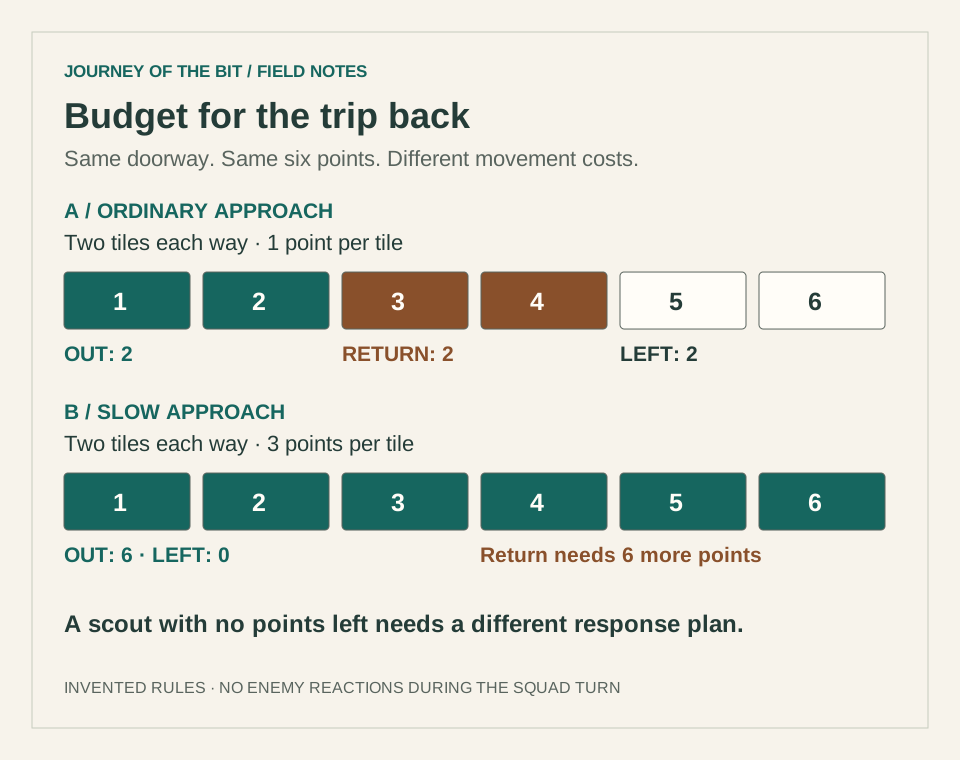
The diagram isolates the scout's budget. It does not promise safety in games with reaction attacks, movement interrupts or different turn rules.
How can terrain costs change a scouting decision?
Higher approach costs can turn a reversible look into a full-turn commitment. Recalculate the return trip and support options when the movement rule changes.
Keep the positions and visibility rules identical, but make the two approach tiles difficult terrain costing three points each. The scout now spends all six points reaching the observation tile. Returning would need another six, so retreat this turn is impossible.
The room provides the same information. The cost of obtaining it has changed dramatically.
The teammates can still spend their turns reaching their supporting positions and attacking visible targets. But “can attack” is not the same as “can rescue”. They may have no shot at the most dangerous enemy, and their attacks may fail. If the scout finishes exposed, someone else having points left does not erase that risk.
A reasonable alternative is to advance the squad only as far as useful positions behind the corner, then end the turn. That gives the teammates their full budgets next turn before the scout commits to the slow approach. It spends a turn on preparation and gives enemies a turn too. With no countdown that may be acceptable, but it is still a tradeoff, and the room could change before the next look.
This is why “always move the scout first” feels too neat. The same discovery can be affordable in one situation and a serious commitment in another.
What does keeping a squad together actually mean?
Keep units able to perform useful supporting actions under the game’s rules. Nearby positions are not enough if walls or action costs prevent a response.
Keeping a squad together does not necessarily mean putting everyone on adjacent tiles. In the example, a nearby teammate behind a corner cannot immediately attack into the room. A slightly more distant teammate with a clear line and enough points might contribute more.
Before relying on support, name the actual action: reach this tile, see that target, then spend this many points. If the plan needs all three steps, check all three. A unit whose entire budget goes on reaching the doorway has arrived, but may not be ready to help.
This connects to our discussion of small squads and tactical depth. A few units can create interesting choices when each has competing jobs. Keeping one available to respond means giving up whatever else they might have done.
When is information worth the risk of scouting?
Information is more useful when it changes a decision you can still make. Consider what each discovery would alter, and remember that visible empty space does not clear hidden corners.
Before taking the first step, ask what each discovery would change. An empty visible area might justify moving a second unit forward. A blocked route might favour another entrance. A dangerous position might justify withdrawing and preparing a different approach.
If every possible discovery leads to the same immediate action, consider whether the information is worth paying for now. It may still matter later, but “more information” is not automatically a good exchange at any cost.
Also distinguish seeing part of a room from clearing it. A doorway view may leave corners concealed. An empty visible area says nothing certain about the space the scout cannot see.
Red Blob Games' interactive visibility article lets you move a viewpoint around obstacles and inspect how the visible region changes. Its grid-line explanation explores drawing lines between grid locations. They are useful geometric resources, rather than rules for how a specific tactical game handles detection or attacks.
What should I check before moving a scout?
Check what the position reveals, what the trip costs and who can respond. Include retreat interruptions and the cost of waiting in the comparison.
- What information can this position reveal, and what remains hidden?
- Can that information change an action still available this turn?
- How many points remain after reaching the observation position?
- Can the scout return, and can enemies interrupt that return?
- Which teammate can actually respond, from where, and at what cost?
- What does waiting cost in turns, objectives or enemy opportunities?
Our note on time units and action points looks more closely at budgeting a turn. The doorway version is pleasingly concrete: count the trip out, count the trip back, and check who can help if the room changes your mind.
A good scouting move buys useful choices. That's the part worth protecting.
Join us on Discord to discuss tactical decisions and the game systems that make them interesting.