A tactical defeat feels fairer when you can connect the outcome to understandable rules, information available before acting, and choices that mattered. That doesn't mean every loss must be avoidable or every danger revealed. It means you can identify what happened and learn something more useful than “don't trust the interface”.
What is the difference between a hard loss and an unclear loss?
A hard loss can follow clearly communicated rules and still hurt. An unclear loss leaves you guessing whether the problem was your decision, an unknown rule, misleading information or a fault in the game.
We'd separate three questions: was the rule applied consistently, could the player understand the risk, and did they have a meaningful opportunity to respond? These are our editorial questions, not a measured formula for player satisfaction. Different players will also disagree about how much uncertainty they enjoy.
Nielsen Norman Group's explanation of system-status visibility connects clear feedback with understanding what a system is doing. Applying that principle to a tactical game is our interpretation: the interface should help you distinguish a risky choice from a command that failed to do what it promised.
A battle can be brutally difficult while doing that well. Conversely, an easy encounter can still teach an unreliable rule if its preview contradicts its outcome.
How can the same defeat teach two different lessons?
The same mechanical outcome can teach a tactical lesson or expose a communication problem, depending on what the player was shown beforehand. Keep the rules fixed and change the warning to see the distinction.
Imagine this hypothetical encounter:
- One soldier has 3 health and two actions. No other unit can help this turn.
- Crossing a marked lane costs one action. Taking a protected detour costs both actions.
- An enemy watches the lane. Entering it triggers one guaranteed reaction shot for 3 damage, immediately removing the soldier.
- The detour never enters that lane and cannot trigger the shot. There are no other attacks or hazards.
- Reaching a switch and activating it requires the detour plus one further action. There is no deadline, so the soldier can activate it next turn.
In version A, the movement preview marks the threatened part of the route and says “Reaction shot: 3 damage on entry”. A visible rule explanation identifies that attack as guaranteed. Taking the shortcut still loses the soldier, but the player had both relevant information and an available alternative.
In version B, the preview says “Safe route”, yet the same shot happens. The loss follows the underlying combat rule but contradicts the route information. Telling the player to be more careful doesn't repair that contradiction.
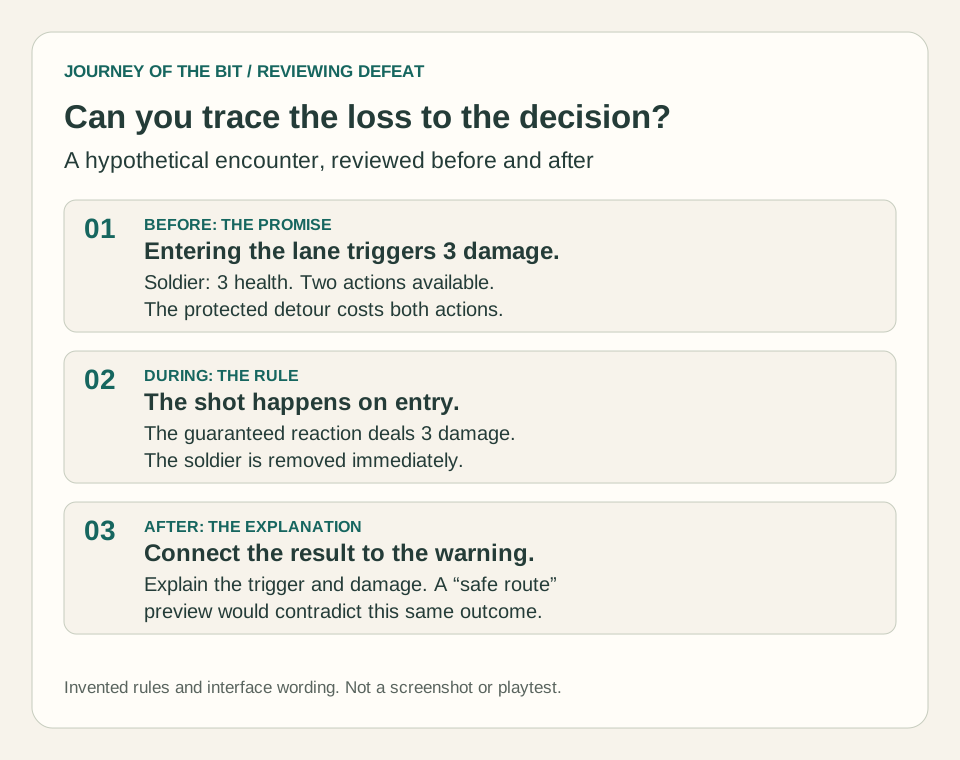
Original hypothetical review diagram. The encounter and interface wording are invented; this is not a screenshot or a reported playtest.
| Review point | Clear version | Misleading version |
|---|---|---|
| Before the move | Threatened route and guaranteed damage are shown | The route is labelled safe |
| During the move | The shot occurs at the stated trigger | The shot contradicts the preview |
| After the loss | The explanation connects entry, reaction fire and damage | A generic defeat message leaves the contradiction unresolved |
The useful fix for version B is accurate route information and an explanation of the trigger. Reducing the enemy's damage might make the loss less severe, but it would leave the misleading promise in place.
Must a fair game reveal every enemy and every outcome?
No. Hidden information can be part of the challenge, provided the game communicates the limits of your knowledge and gives uncertainty a meaningful place in decisions.
A room marked “unexplored” makes a different promise from a room marked “clear”. Likewise, a remembered enemy position is different from a currently observed one. Our guide to fog of war and line of sight explores that distinction.
We'd ask whether a player could recognise the unknown and choose how to approach it. Scouting, delaying or accepting exposure can all matter when their costs are understandable. An ambush need not be announced square by square, but discovering a new rule only through an unavoidable fatal consequence deserves a different review from knowingly entering uncertain territory.
A warning also has to be perceptible. Game Accessibility Guidelines advises against conveying essential information through a fixed colour alone. For the invented lane, a label and distinct pattern could support its colour. Our article on tactical icons beyond colour develops that idea.
Can a random outcome be fair even when the plan was sensible?
Yes. A clearly explained risk can produce an unwelcome outcome without proving the decision was poor. Fairness also depends on how the game communicates that risk and what consequences it attaches to failure.
This is where reviewing a loss differs from simply replaying it until the roll succeeds. Ask what was knowable when the action was chosen, and whether the downside was acceptable then. Our worked example of taking a shot or improving position compares those consequences in detail.
We wouldn't use a single unlucky result as proof that the displayed odds are wrong. Equally, “that's randomness” isn't an explanation for a misleading damage preview or a rule applied inconsistently. Those are separate claims that need separate evidence.
What should you record when a defeat feels unfair?
Record the promise, the action and the outcome before deciding on a fix. That gives someone else a specific moment to investigate.
- Note the game version, settings and relevant unit state.
- Capture the warning or preview, if possible.
- Describe the command and the exact point where the outcome differed from your expectation.
- Identify any alternative you understood to be available at the time.
- Separate what you observed from what you think caused it.
Our guide to useful tactical-game feedback has a fuller reporting framework. What loss taught you a useful lesson, and what made it understandable? Join the studio Discord to discuss games and game development.