Take the shot when its possible payoff is worth the consequences of missing, and move when the new position leaves you with a more acceptable next turn. Compare the objective, exposure and remaining squad actions before comparing percentages. A high chance to hit can still be a poor choice if one miss breaks the whole plan.
What should you check before trusting the hit percentage?
Check what a hit achieves, what a miss permits, and what moving costs. The number describes one uncertain event; it doesn't describe the value of your entire turn.
A hit might wound a target without stopping its next attack. A move might protect one soldier while leaving an objective vulnerable. Neither outcome is captured by a bright “60%” beside the fire button.
We'd start with these questions:
- Does a hit remove the threat, or merely damage it?
- What can that threat do if it survives?
- Does movement actually prevent that response?
- What action or objective do you give up by moving?
- Is another squad member still able to help?
Check the action budget too. In a game where movement consumes the final action, “move, then shoot” isn't an available compromise. Our guide to time units and action points explores why those costs change a turn.
How do shooting and moving compare in a concrete encounter?
In this hypothetical encounter, shooting offers a chance to preserve everything, while moving guarantees the soldier's survival at a cost to the objective. Those are different promises, even though both choices use one action.
Imagine a soldier defending a relay. These invented rules apply only to this example:
- The soldier has 4 health and one action left. The relay has 3 health. Preserve both if possible.
- An enemy has 5 health. Shooting costs one action and one round, with a 60% chance to deal 6 damage and a 40% chance to deal zero. There are no critical hits or armour.
- Moving costs one action and reaches a solid wall that completely blocks the enemy's attack on the soldier. The route is safe and involves no reaction attacks.
- If alive after this action, the enemy attacks once: it deals 4 damage to an exposed soldier, or 2 damage to the relay if the soldier is protected. Those attacks cannot miss.
- There are no other enemies, allies with actions, or additional costs. We compare the state after this enemy response, not an entire mission.
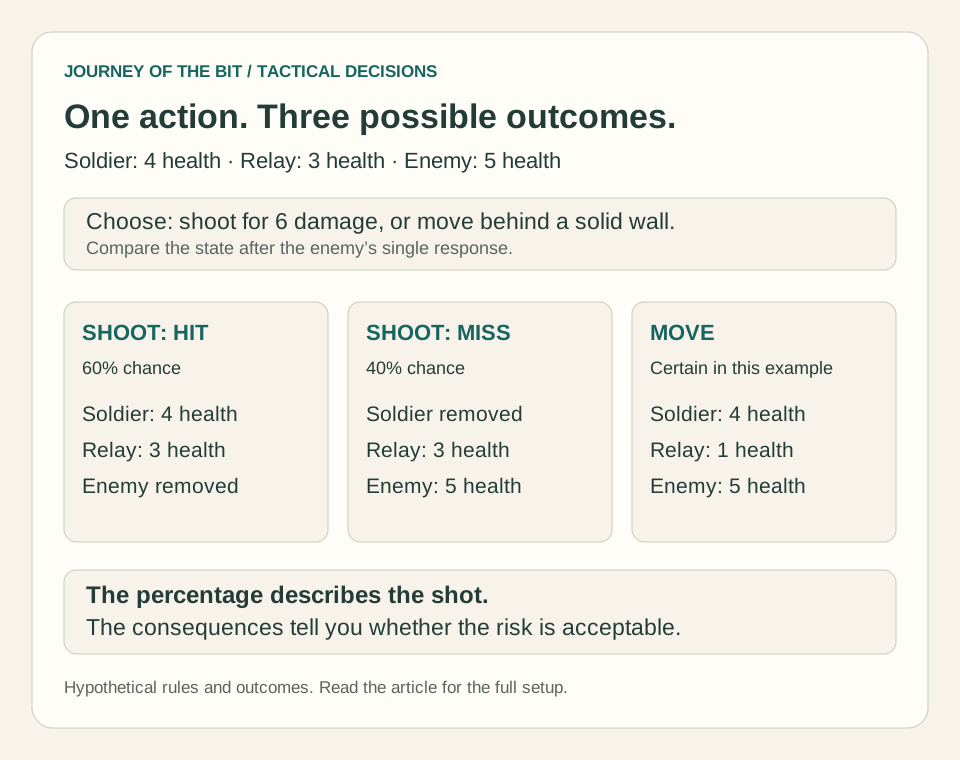
Original hypothetical decision diagram. Protection is guaranteed only by the invented rules above; the outcomes are not taken from a particular game.
| Choice and result | Soldier afterwards | Relay afterwards | Enemy afterwards |
|---|---|---|---|
| Shoot and hit: 60% | 4 health | 3 health | Removed |
| Shoot and miss: 40% | Removed | 3 health | 5 health |
| Move: certain under these rules | 4 health | 1 health | 5 health |
If losing the soldier is unacceptable, moving is the defensible choice here. It keeps both soldier and relay alive through this response, but leaves a dangerous next turn. If preserving every point of relay health matters more, shooting offers that possibility without guaranteeing the soldier's survival. That's the actual tradeoff.
Why doesn't expected damage settle the decision?
Expected damage summarises a long-run average, not what this particular shot will do. It also leaves out consequences such as losing a soldier or allowing an objective to be attacked.
OpenStax explains expected value as the sum of outcomes weighted by their probabilities. For the invented shot's raw damage, that is 0.6 × 6 + 0.4 × 0 = 3.6. The shot never actually deals 3.6 damage: it deals six or zero.
That distinction matters when the enemy has five health. The useful question is whether it remains able to act, not whether average damage nearly fills its health bar. You can use averages to compare repeated opportunities, but don't let them erase a failure you cannot afford.
When does the better choice change?
The choice changes when the consequences, available actions or objective requirements change. Keep the percentage identical and you can still get a very different decision.
Suppose the relay starts with only 2 health instead of three, and losing it immediately fails the mission. Moving now guarantees mission failure after the enemy response. Shooting gives a 60% chance to prevent that failure, although its miss branch still loses the soldier. “Always take cover” would be terrible advice under those revised rules!
Alternatively, give an ally a remaining action and a guaranteed way to remove the enemy after a miss. The shot's downside changes, but using that backup may consume a resource needed elsewhere. Check whether the ally truly has range, ammunition and a legal target before counting on it. Seeing a target and being able to shoot it are separate questions.
How can you review a bad result without learning the wrong lesson?
Review what was knowable before acting, including the alternative you rejected. A successful gamble doesn't prove the plan was sound, and a miss doesn't automatically make it foolish.
Write down the expected failure branch before taking an important shot: “If this misses, the soldier is exposed and nobody can help.” Afterwards, ask whether that consequence was acceptable and whether a better option existed. If an unexpected rule caused the loss, investigate that rule before changing your attitude to risk.
For geometry questions, Red Blob Games' grid-line guide shows several ways to trace lines across cells. It's useful background, not documentation for any particular game's targeting system.
Our preference is to judge the plan by how honestly it accounts for failure. Sometimes that means moving. Sometimes the risky shot is the only remaining chance. What's your deciding factor? Join the studio Discord to discuss tactical games and the decisions behind them.