Line of sight concerns whether there is an unobstructed view between positions under a game's visibility rules. Fog of war controls which information about the battlefield the player receives, including what remains visible after units look elsewhere. They often work together, but remembering a room is different from observing it now.
That distinction can change a perfectly sensible plan. You remember an empty room beside a corridor. Its floor plan is still on the screen. Does that mean the room is still empty, or only that nobody has looked inside recently?
We like this question because it gets beneath the familiar grey tint. The useful thing to understand is what the display lets you claim about the world.
What does line of sight actually tell me?
Line of sight establishes whether something blocks a view between positions according to the game's rules. Range, facing, lighting or concealment may impose additional conditions, so a geometrically clear line does not necessarily reveal everything along it.
A simple hypothetical system might treat walls as opaque and open floor as transparent. Move a unit behind a corner and the wall blocks its view into the adjoining room. Step back to the doorway and some of the room becomes visible again.
Red Blob Games' visibility article demonstrates how a viewpoint and obstacles define a visible region. It also discusses restricting that region by distance or direction. Those diagrams help explain geometry; they do not specify the detection rules of every tactical game.
The companion grid-line explanation explores drawing lines between grid locations. On a tiled map, the way a line passes through cells requires implementation choices. A player should check the game's previews and documented rules rather than assume that a line which looks clear must count as clear.
What does fog of war hide or remember?
Fog of war limits the battlefield information shown to the player. A game may distinguish unexplored space, previously explored space and space currently observed, but the details of those states vary.
For the invented example in this article, unexplored rooms have no revealed layout. Exploring a room records its walls and floor permanently. Leaving removes its occupants from view, while the recorded layout stays visible. There are no sensors, sound markers or last-known enemy icons in this example.
These rules deliberately separate stable map knowledge from current activity. Knowing where a room is can help plan a route. It does not establish who has entered it since the last observation.
| State in this invented system | Information available | What it does not establish |
|---|---|---|
| Unexplored | No revealed room layout | The room's shape or occupants |
| Explored, not currently observed | Remembered walls and floor | Whether the room is still empty |
| Currently observed | Visible floor and occupants within view | What is behind another obstruction |
The table describes our example, not a universal definition of every game's interface. Some games reveal a whole map in advance, retain more information or use different terms.
How can a room be known but no longer visible?
A room can remain on the map because it was explored earlier, even when no unit currently sees it. Treat that display as a record of an observation, rather than a fresh report about its contents.
Imagine a squad member entering a small storeroom on turn one. The visible floor is empty. On turn two, the unit leaves and moves around a corner; no teammate watches the room. The layout remains visible under the invented memory rule, but current occupants do not.
At the start of turn three, the player wants to send someone back through it. The correct statement is “that route was empty when observed”. “That route is empty now” needs a new observation or another rule that supplies current information. An opponent may have moved there during the intervening turn; the example does not assume that one actually did.
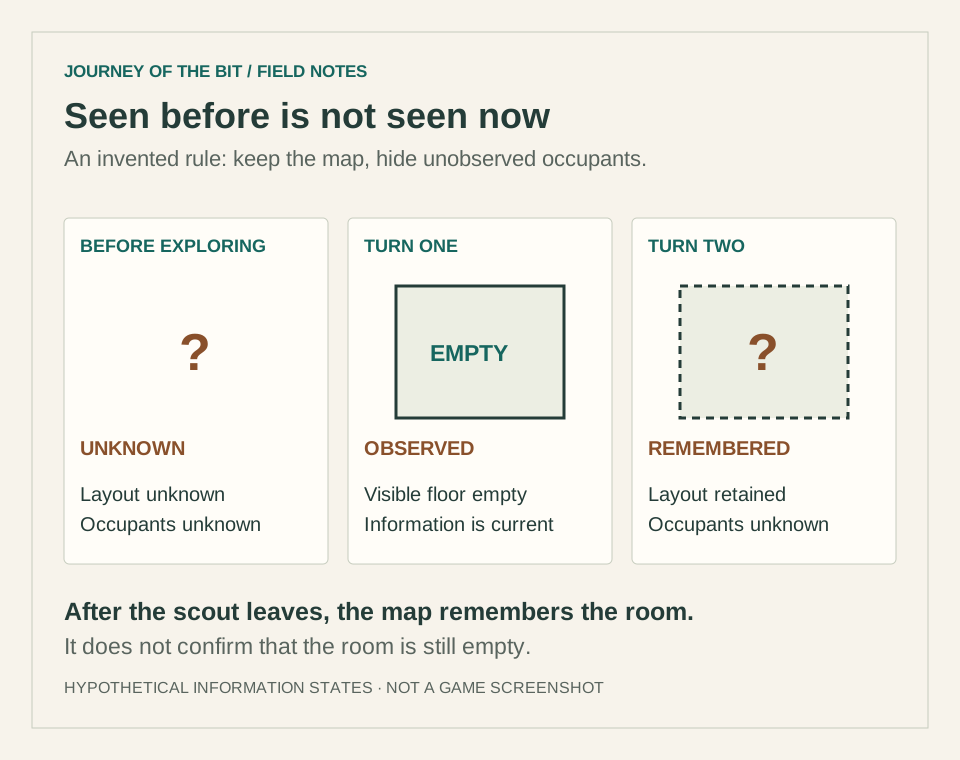
This original diagram shows the information available to the player, not the hidden state of a real game. The question mark means unknown occupants, not a detected enemy.
Our doorway scouting article considers what it costs to obtain a new observation. Information can be valuable without being free to gather.
Does shared squad vision mean the selected unit can see everything?
Shared vision can show the player information gathered by another squad member. That does not by itself establish that the selected unit has its own unobstructed view or a legal attack.
Add one rule to the example: the player sees the combined observations of all friendly units. One teammate watches the storeroom while another stands behind the corridor wall. The player now has current information about the room, but the unit behind the wall still lacks a direct view into it.
Whether that unit can act on shared information depends on the particular action's rules. Keep player knowledge, a unit's view and permission to perform an action separate. This article explains the information distinction; weapon targeting introduces additional questions.
How should an interface distinguish remembered and current information?
Use distinct cues for remembered terrain, currently observed space and unknown activity. Labels, outlines or patterns can explain the difference alongside colour, especially when the distinction changes a player's decision.
In the invented room display, a solid outline and an “observed now” label could accompany current vision. A dashed outline and “last observed: turn one” could identify remembered terrain. Those are proposed interface choices, not claims about an existing game.
Avoid making remembered information look like a live report. If a game retains an enemy's last-known position, its marker should communicate that uncertainty instead of appearing identical to a currently seen unit. Our battlefield readability guide looks at how shapes and labels can support those distinctions.
What should I check before trusting the map?
Ask where the information came from and whether it is current. Then check which game's rules govern memory, shared observations and hidden activity.
- Was this area observed now, seen earlier or revealed by another source?
- Does remembered terrain retain current occupants or only the layout?
- Is a marker a present observation or a last-known position?
- Is this the selected unit's view or a teammate's shared information?
- What remains hidden behind obstacles even within the explored room?
“Do I know this now, or did I know it earlier?” is a surprisingly useful question to bring to a tactical turn. A clear interface helps you answer it before the plan depends on getting it right.
Join the studio conversation on Discord to discuss tactical games and the rules that make their decisions interesting.