Look for the decisions you want to repeat: flexible turns, lasting squad consequences or careful exploration with limited information. Choose two priorities, then verify them in ordinary gameplay and official documentation. Similar screenshots alone cannot establish that a game offers the same experience.
We'd split a shortlist into three questions. What decisions happen during a turn? What carries forward after the battle? And how much information do you have before committing? Similar screenshots can hide very different answers.
If you want to revisit the original games themselves, OpenXcom is worth investigating. It is an open-source recreation that requires resources from a copy of the original games. It isn't a separate new campaign to buy instead of them.
If you want to explore neighbouring ideas, look at the official pages for Pathway and Invisible, Inc. The former presents an adventure with turn-based combat; the latter centres on tactical espionage. Those are starting points for comparison, not a claim that either reproduces every part of X-COM.
Then watch an ordinary turn. Not just the exciting attack montage! Watch what the player checks, which choices they decline, and what happens between actions. That tells you much more about the kind of thinking a game invites.
We’re a studio passionate about games and the craft behind them. This journal explores the decisions that make you lean forward in your chair, and why they work.
How do I shortlist games like the original X-COM?
Choose two experiences you want to keep and one feature you would happily change. Use those priorities to compare observable decisions rather than visual resemblance.
‘Like X-COM’ can mean quite different things to two players. One wants detailed control of equipment and movement. Another wants a campaign full of soldiers they become attached to. A third wants that slightly horrible pause before opening a door. Before looking at another trailer, choose two things you want to keep and one thing you would happily change.
For example: ‘I want flexible turns and lasting squad consequences, but I’m happy with a different setting.’ That gives you something to check. ‘I want the same atmosphere’ is a perfectly reasonable starting feeling, but it needs translating into things you can observe: limited information, sound, pacing, visual style, or the cost of a mistake.
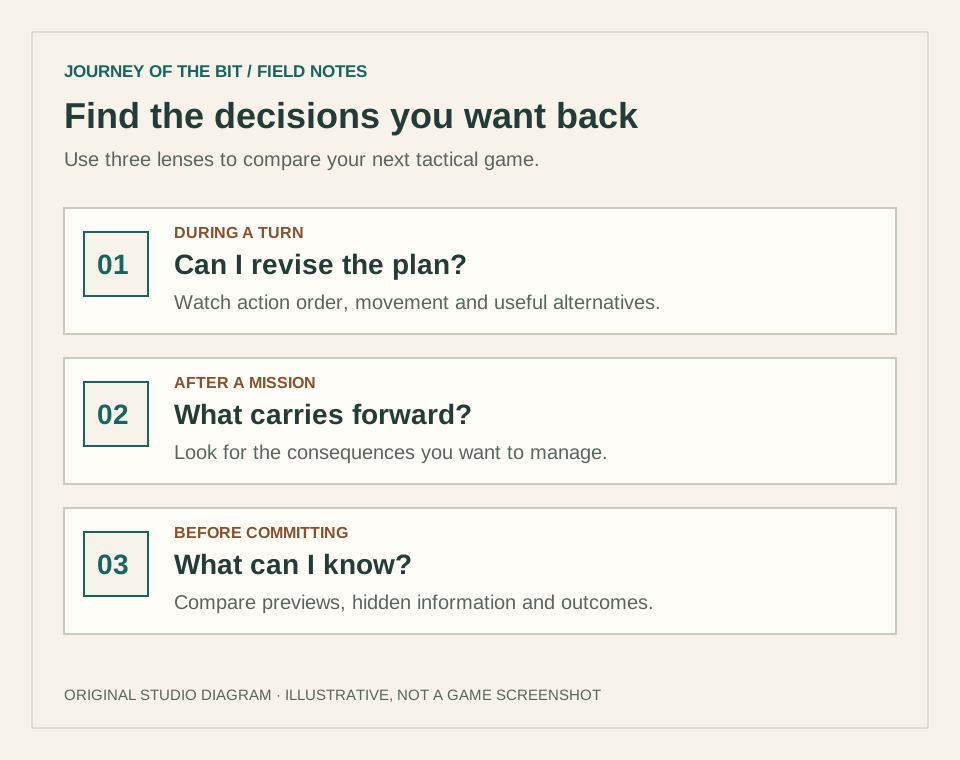
An original comparison checklist. Use the same three questions for every game on your shortlist.
Which tactical decisions should I compare?
Compare freedom during a turn, consequences after a mission and information available before commitment. Together, these reveal more about the experience than a shared camera angle.
What can I change during a turn?
Check whether you can redirect a unit, mix actions or let another teammate respond. The order and cost of actions determine which plans remain possible.
Imagine a unit reaching a corner and finding a blocked route. Can you redirect it, spend the remaining movement elsewhere, or hand the problem to another squad member? Watch whether actions can be mixed, whether their order matters, and whether the interface shows the cost before you commit. More available buttons don’t necessarily mean more interesting choices. We’d rather see two plausible plans than six ways to do the obvious thing.
What carries over after a mission?
Check whether equipment, injuries, upgrades and relationships persist. These consequences help distinguish a campaign about nurturing a roster from a sequence of self-contained battles.
Look at the quiet part after the battle. Does the player replace lost equipment, decide who rests, choose an upgrade, or head straight to the next encounter? None of those structures is automatically better. They create different reasons to care. If your favourite part is nurturing a roster, a wonderful standalone battle system might still leave a gap.
What can I know before committing to a move?
Inspect the destination, movement range and any available sightline or enemy-intention previews. Compare the preview with the result to separate deliberate uncertainty from unclear presentation.
Pause a gameplay video before a move and list what the player knows. Is the destination visible? Are enemy intentions shown? Can the player inspect movement range or line of sight? Then compare the result with the preview. This helps separate uncertainty you enjoy from an interface that merely makes useful information hard to find.
How can I compare tactical games in ten minutes?
Watch an ordinary turn and a transition between missions, using the same prompts for every candidate. Record both what you observed and what still needs verification.
Use an uncut mission video or a demo where one is available. Start during an ordinary turn, then watch a transition between missions. Keep a tiny notebook with the same prompts for each candidate:
- One decision I wanted to make myself.
- One consequence that would matter in the next mission.
- One rule the interface explained clearly—or left unclear.
- One thing I still need to verify in the manual or a longer playthrough.
Leave unknown answers as unknown. A short clip cannot establish how a whole campaign develops, and a promotional montage cannot tell you how often its most exciting moment happens. Your shortlist should record evidence and unanswered questions, not award a pretend precision score out of ten.
A useful final question is: would I still want to play this if the camera angle and art style changed? If yes, you’ve probably found a match in the decisions themselves. If no, the presentation may be an essential part of what you love. That counts too!
For a closer look at turn structure, see our worked example of time units and action points.
Which part of classic tactics are you looking for next? Follow this journal for more notes on squad tactics and game development.