Choose a tactics game you can stop safely and return to without rebuilding your entire plan from memory. Check when it saves, what quitting preserves, and how it explains the situation when you return. A short mission is useful, but a longer mission with reliable stopping points may fit your evening better.
Our earlier guide to comparing tactical games explores which decisions you enjoy. This note tackles a different question: can those decisions fit the time and attention you actually have? Here is our proposed way to find out, with an invented comparison rather than a ranking of games.
What does a short session need to include?
Count everything from launching the game to leaving it safely, including the time spent remembering your plan. Battle length alone leaves out part of the commitment.
Imagine you have half an hour after dinner. Loading a save, checking the squad, choosing equipment and remembering why someone is guarding a doorway all come out of that same half-hour. None of those activities is inherently wasted time. You might love tinkering with equipment! The question is whether you get enough of the part you came for before you need to stop.
Write a plain requirement: “I want to make a few satisfying tactical decisions and be able to leave when interrupted.” That is more useful than demanding that every mission finish in twenty minutes. Decide whether finishing a battle matters to you, or whether making progress within one feels satisfying enough.
Why should you check saving separately from pausing?
Pausing answers whether you can step away now. Saving and resuming answer whether you can close the game and continue later. Verify both for the mode you intend to play.
The Game Accessibility Guidelines on manual saves explain that checkpoint-only saving can exclude people who need short sessions or must stop unexpectedly. The guidance recommends manual saving alongside autosaving. Our selection advice follows from that principle: treat the ability to leave as a practical requirement, not a bonus tucked beneath the combat features.
Look for a precise description of the save behaviour. “Autosave supported” does not tell you whether it records every action, each turn or only a completed mission. A suspend option might preserve one interrupted session without providing reusable save slots. Check what the documentation actually promises, including any restrictions in challenge modes.
Do not test an uncertain quit option on a treasured campaign. Use a disposable practice save or demo where available, read the exit prompt, and establish what will be lost before confirming.
How can two hypothetical games fit the same evening differently?
Compare the point where you can leave, not just the expected finishing time. The following invented rules show why a longer encounter can still fit a shorter session.
Imagine two candidates. Game A has battles that take this hypothetical player about fifteen minutes, but saves only after a battle. Game B has forty-minute battles and saves the exact state whenever the player chooses to quit. These are made-up timings and rules, not observations of existing games.
| Question | Hypothetical Game A | Hypothetical Game B |
|---|---|---|
| What happens if you must leave after eight minutes? | Current battle progress is lost | Current battle state is preserved |
| Can you finish a battle in a twenty-minute slot? | Possibly, with little room for preparation | Not under the assumed timing |
| What needs checking when you return? | How much of the battle needs replaying | Whether the saved position is easy to understand |
If interruptions are common, B meets the stopping requirement better. If completing a whole battle is the pleasure you want and your time is predictable, A may suit you. Neither answer establishes which game has better combat.
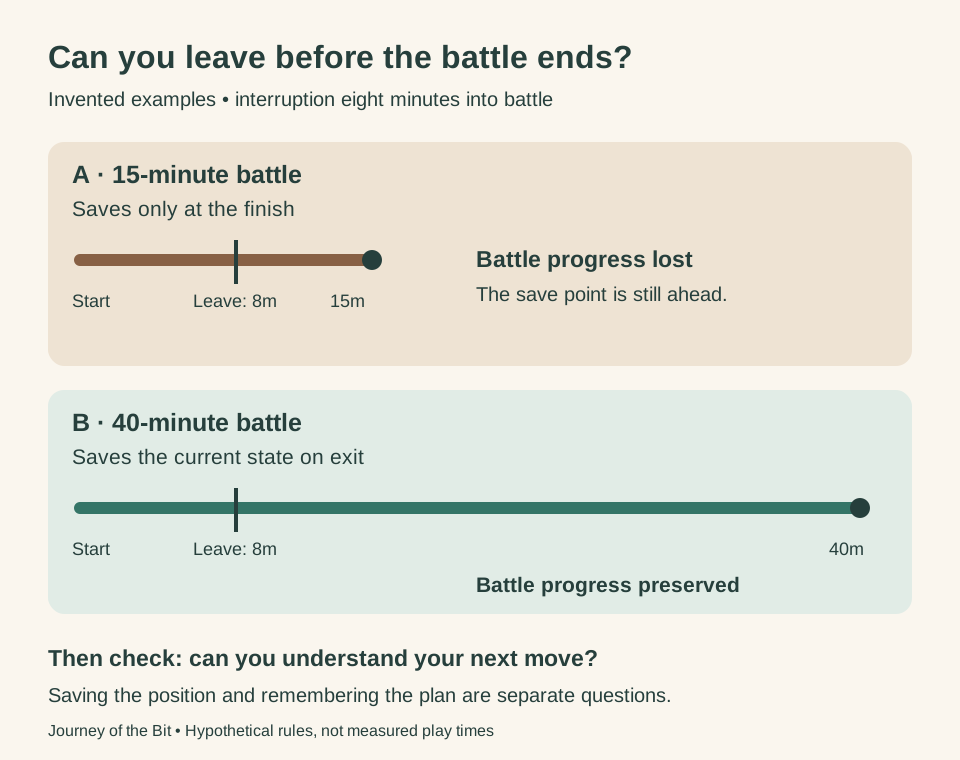
Original hypothetical comparison, not a screenshot or a timing test. The marker shows an interruption eight minutes into each battle; save rules determine what survives it.
What makes a saved battle easy to return to?
Look for enough visible context to reconstruct the next decision: your objective, remaining actions, current threats and relevant squad status. Preserving the board does not automatically preserve your intentions.
The Game Accessibility Guidelines on objective reminders describe reminders as useful when players have difficulty recalling their goal, including after long breaks. Our tactical application is to inspect what the game tells you before you issue another order.
Can you identify who has already acted? Can you inspect the objective without dismissing something important? Can you work out why a unit is exposed? A mission summary may explain the goal while leaving your intended action sequence entirely up to you.
A brief personal note can help: “Keep the medic back; check the left route before advancing.” That is an optional workaround, not proof that the interface communicates well. If you regularly spend your available time deciphering yesterday's plan, factor that into your choice.
How can you check a candidate without turning it into homework?
Use one ordinary interruption and one return as a small personal trial. Record what happened, then stop investigating once you can make a useful decision.
- Confirm the platform, mode and save restrictions in current documentation.
- If a suitable demo or owned copy is available, reach an ordinary tactical decision.
- Use the documented save-and-exit process, then return later.
- Check which progress survived and how quickly you understand your next options.
- Decide whether that experience fits your available time and preferred pace.
A tutorial alone may not represent later battles, so leave that limitation in your notes. If you cannot verify saving before buying, mark it as unresolved rather than assuming that turn-based play guarantees convenient interruptions. For device-related questions, use our separate laptop suitability checklist.
We'd choose the game that makes a satisfying session possible on an ordinary evening. Which matters more to you: finishing a battle, or knowing you can comfortably leave halfway through? Join the studio conversation on Discord to discuss games and the small design choices that help them fit into life.