Compare the decisions a game asks you to make before, during and after a mission. A screenshot can show a squad, a grid and some excellent coats. It cannot show whether you will spend your evening managing a campaign, planning an infiltration or recovering from a turn that went spectacularly wrong.
Start by naming the part of squad tactics you actually want more of. Is it carefully budgeting movement? Getting attached to a team? Choosing which emergency deserves scarce resources? Two games can share a visual language and satisfy very different parts of that appetite.
We are a studio passionate about games and discussing how they work. For a useful comparison, we'd rather make the criteria visible than hand you a mysterious score. Here is a small framework you can use when building your own shortlist.
How do I decide what I want from an XCOM-like game?
Name two experiences you want more of and one feature you would prefer to avoid. Those preferences tell you what evidence to seek.
“Something like XCOM” is a reasonable starting point. It becomes more useful when you add a specific experience: “I want more turns where moving one soldier changes everyone else's options.” Or perhaps: “I want to carry a battered team through a campaign and live with the consequences.”
Those preferences suggest different things to investigate. The first calls for footage of ordinary positioning decisions. The second needs evidence about persistence between missions. Neither can be settled by counting how many soldiers appear in the promotional artwork.
Write down two priorities and one thing you would prefer to avoid. For example: meaningful movement choices, persistent characters, and minimal equipment administration. This is a preference, not a verdict on whether equipment administration is good design. Plenty of us enjoy a proper inventory fiddle!
What should I compare before a tactical mission?
Check what preparation commits and whether choices change the next encounter. Distinguish lasting resource decisions from a routine reset.
Look for choices that affect what happens next. Can you choose the mission, the team or the equipment? Do those choices spend resources needed elsewhere? Is preparation a brief selection screen or a substantial part of the game?
An equipment menu alone does not establish depth. Watch whether changing a loadout changes the player's approach. A tool that opens an alternative route creates a different decision from a weapon that simply adds a little damage.
Also distinguish a campaign decision from a routine reset. If every encounter begins with a fresh, fixed team, that may suit someone who enjoys self-contained challenges. If resources and injuries persist, investigate how much attention the game asks you to give them. Persistence can create attachment, but it can also create maintenance you might not want this week.
What should I watch during an ordinary tactical turn?
Watch the information inspected, options rejected and actions still available after commitment. Uninterrupted footage helps reveal how decisions connect.
Trailers naturally favour the dramatic moments. Try to find uninterrupted gameplay that shows how a player reaches one of those moments. You want to see the hesitation, the inspected tile and the option they decide against.
Notice what consumes their attention. Are they checking sightlines, measuring movement costs, sequencing abilities or trying to stay undetected? Does the interface explain the likely result before commitment? When something unexpected happens, what choices remain?
Our note on time units and action points offers one way to examine the movement budget. The doorway scouting exercise shows why the ability to respond after discovering danger matters too. These are useful questions to bring to footage, rather than rules every tactics game should share.
Do not infer a complete ruleset from one clip. A tutorial, unusual character build or late-game ability can make an encounter unrepresentative. Note what you observed and leave the broader claim open until another source supports it.
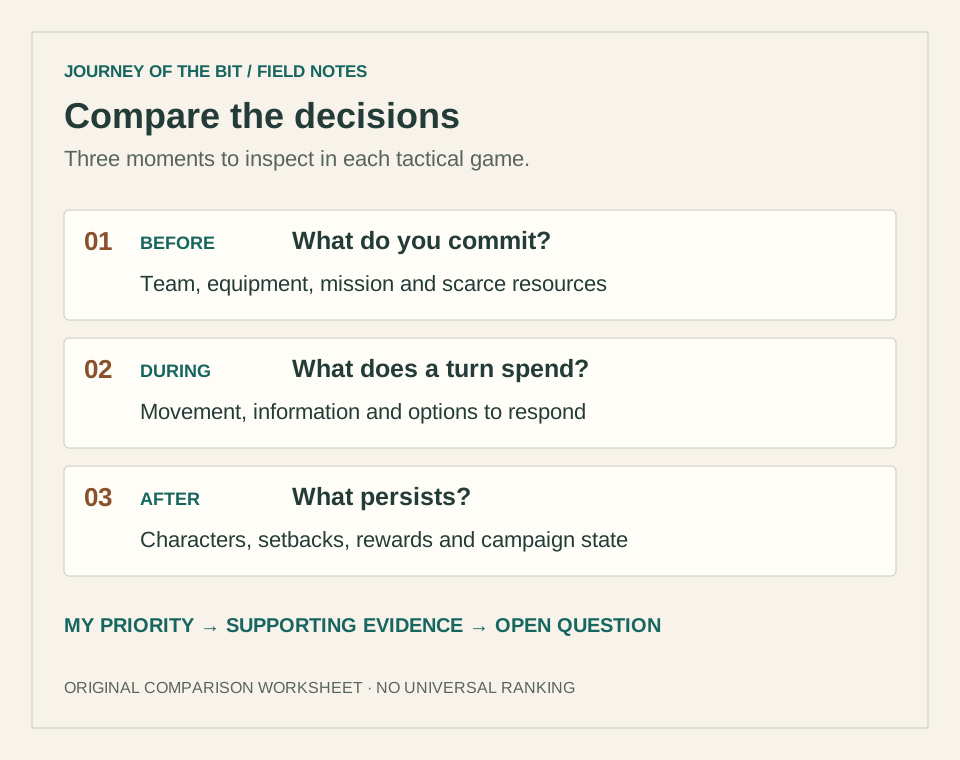
Use this as a worksheet for each candidate. An unanswered question is more useful than a confident guess based on familiar-looking graphics.
What should I check after a tactical mission?
Look for characters, injuries, resources and consequences that carry forward. Verify what failure changes rather than assuming a particular campaign structure.
Watch beyond the victory screen. Which characters, injuries, items or resources carry forward? What happens after failure? Can a campaign continue with a setback, or does the attempt end?
The answer changes the emotional texture of a tactical decision. Losing a resource that matters later is different from spending something that resets immediately. Neither approach is automatically deeper. They put the pressure in different places.
Be precise about the evidence. Seeing a character gain an upgrade establishes that upgrade in that situation. It does not prove that every character persists indefinitely or that the game has a particular campaign structure. If long-term consequences are your main priority, verify them in documentation or footage that actually covers those consequences.
How do Pathway and Invisible, Inc. describe their tactical focus?
Pathway’s official overview combines expedition choices with squad combat, while Klei presents Invisible, Inc. around infiltration, stealth and teamwork. These descriptions suggest questions to investigate rather than a universal winner.
The official Pathway website describes a pulp expedition with turn-based squad combat, cover and positioning, equipment choices, and story events between locations. That makes it a useful starting point for investigating how travel decisions and encounters fit together. It does not tell you how much you personally will enjoy the pacing of an ordinary battle.
Klei's Invisible, Inc. page presents infiltration built around stealth, precision and teamwork. A sensible follow-up is to watch how a player gathers information and handles detection. The page also describes the Contingency Plan expansion separately, so check whether any footage you use includes that expansion before treating it as evidence about the base game.
These descriptions establish different emphases. They do not establish a winner, and a developer's overview cannot answer every question about friction, difficulty or replay value. Use it to identify what to investigate next.
How do I keep a useful tactical-game shortlist?
Record a personal priority, supporting evidence and an unresolved concern for each candidate. Leave unknown details open instead of giving guesses a numerical score.
| Moment to inspect | Main question | Evidence to look for |
|---|---|---|
| Before a mission | What am I committing? | Team selection, equipment tradeoffs and resource costs |
| During a turn | Which options remain? | Movement previews, action order and responses to surprises |
| After a mission | What persists? | Character changes, resource losses and the result of failure |
For each game, record your strongest reason to try it, one concrete piece of evidence and one unresolved concern. Avoid averaging everything into a score before you know which differences matter to you.
- What did I actually see or verify?
- Which of my two priorities does it support?
- What happens after a poor decision?
- Is the evidence about the version and mode I would play?
- What still needs checking before I spend money or time?
A shortlist can stay short. One well-understood candidate is more useful than twenty games grouped together because their screenshots share a camera angle.
The artwork might get you interested. The decisions are what you will spend time with.
Join us on Discord to swap tactical recommendations and explain what made a game click for you.