“XCOM-like” is shorthand for a resemblance to XCOM, usually involving turn-based squad tactics and sometimes a campaign of research, recruitment and lasting consequences. It is useful as a starting description, but it does not specify a complete set of rules. Ask which XCOM the comparison refers to, and whether the resemblance is in the battles, the campaign or both.
We'd treat the label as the beginning of an explanation. “Like XCOM, but…” can be a handy invitation. The words after “but” often tell you more about the game you are actually going to play.
Is XCOM-like the same as turn-based tactics?
Turn-based tactics describes how local battles are organised; XCOM-like adds a comparison with a particular series. A game can offer turn-based tactical decisions without reproducing XCOM's campaign structure, setting or rules.
For this discussion, tactics means the immediate problem: where units stand, which actions they take, and how their choices work together. Strategy means the broader allocation of resources and priorities across encounters. Those are working definitions for understanding the label, not a test that every game must pass.
Imagine a battle in which two units must distract a guard while a third reaches an exit. Planning their movement is a tactical problem. Deciding whether that mission is worth risking an experienced team when another emergency needs attention is a strategic one. The same game can contain both, but showing the first does not establish the second.
The publisher's XCOM 2 description illustrates that combination: it describes soldier classes and tactical combat alongside a mobile headquarters, research and equipment upgrades. Those are documented features of that game. They are not automatic features of every game compared with it.
Which XCOM does the comparison refer to?
Ask for the specific game or version. A reference to the original X-COM and a reference to XCOM 2 point to different starting places, even when both speakers care about squad tactics.
The names can be confusing before you get anywhere near a battlefield. The OpenXcom project README identifies the original UFO: Enemy Unknown as X-COM: UFO Defense in its US release. It also explains that OpenXcom recreates the original games and requires their resources. Meanwhile, XCOM 2's publisher describes it as the sequel to the 2012 XCOM: Enemy Unknown.
That distinction matters in a recommendation request. Someone asking for the feel of the original may be pointing at a different set of decisions from someone asking for another campaign resembling the later series. A familiar name alone does not resolve that ambiguity.
You don't need a history lesson every time you mention the genre. Simply say which game you mean, then name the feature you want to discuss. “I mean the action budget” is much clearer than expecting everyone to attach the same rules to the spelling. Our time units and action points explanation explores that particular distinction with hypothetical budgets.
Does an XCOM-like need a base, research or permanent losses?
The label alone cannot establish any of those features. Describe them separately, especially when they are the reason a player is interested.
Here is an invented pair of games to show the difference. Both use a grid, turn-based squads and uncertain attacks. In Game A, each battle starts with a fresh team and fixed equipment. In Game B, the same squad continues between missions, injuries affect availability, and a shared supply budget pays for replacement equipment. These are hypothetical rules, not descriptions of released games.
The two games could look similar in a combat screenshot. Yet a risky move has a different reach in each. In A, losing a unit changes the current battle. In B, it also changes who can take part next time and what equipment the team can afford. The difference is the connection between battles, not the camera angle.
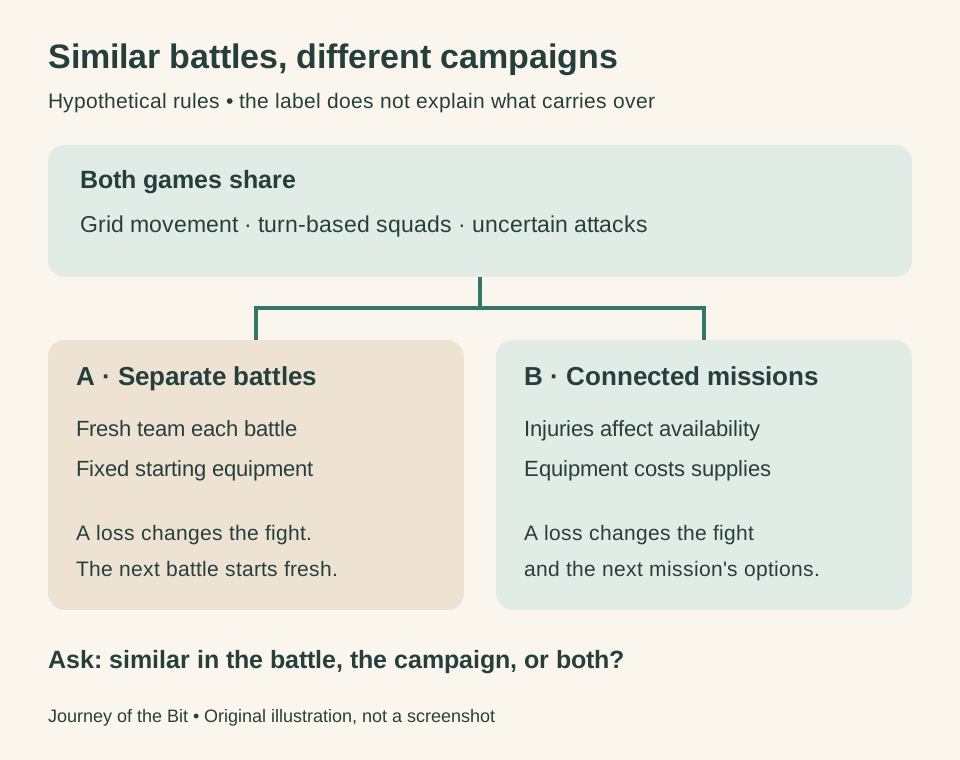
Original explanatory diagram using invented rules. The shared battle description does not tell you whether consequences carry into another mission.
Permanent loss is another separate question. An injury, a temporary absence and a character being gone for good are different rules. Likewise, having an upgrade screen does not tell you whether research competes for scarce resources. Spell out the consequence instead of letting the genre label do all the work.
Can a game share tactical ideas while having a different focus?
Yes. A shared interest in positioning or team coordination can support very different objectives and pacing. Describe the common element and the difference together.
Pathway's official overview describes turn-based squad combat using cover and positioning within an expedition of story encounters. Klei's Invisible, Inc. overview emphasises infiltration, stealth and teamwork. Those descriptions give us more precise language than simply putting both under the same comparison label.
These are examples of how developers describe their own games, not reviews or a claim that either developer uses “XCOM-like” as its official genre. Our interpretation is that the tactical resemblance becomes useful only when accompanied by the game's own focus. An expedition choice and an infiltration problem can ask quite different things of the player.
How can you make an XCOM-like description more useful?
Complete the comparison with one shared feature and one meaningful difference. That gives another reader something concrete to understand or verify.
Try these prompts when describing a game or asking for recommendations:
- Which XCOM title am I using as the reference?
- Is the resemblance about squad actions, campaign management or presentation?
- Which consequences persist after a battle?
- What changes the player's main objective or routine?
- Which details have I verified, and which am I assuming from the label?
An invented description might be: “It shares turn-based squad positioning, but each encounter uses a fresh team and there is no campaign resource management.” That says considerably more than “XCOM-like with a different setting”. It also leaves room for the game to be interesting on its own terms.
For evaluating actual candidates, continue with our guide to comparing games beyond their screenshots. Here, the useful takeaway is simpler: a resemblance is a clue about what to explore, not a promise that every favourite system will be there.
What do you expect when someone says “XCOM-like”? Join the studio conversation on Discord to discuss games, genre labels and the decisions behind them.