A tactical game can develop its own identity by making a particular kind of decision central to play. Choose what the player is trying to achieve, what competes with that goal, and which consequences the game rewards. Familiar movement and combat rules can feel different when they serve a different purpose.
Our view is that identity becomes convincing when players can describe a decision they kept making, not just an unusual feature on the store page. Art, sound and writing matter too. The useful design question is how those elements support the same experience rather than pull attention in different directions.
What should a tactical game's central idea describe?
Describe what the player does under pressure. A central idea is more useful when it helps choose rules and reject distractions.
“Every mission is about getting vulnerable people safely across contested ground” suggests priorities: route planning, protection and the cost of leaving someone exposed. “A deep tactical adventure with unique mechanics” leaves almost every design decision open. The first sentence is not necessarily a better commercial pitch, but it gives a designer something concrete to work with.
For a real example of a clearly stated focus, Klei's official Invisible, Inc. overview centres infiltration, stealth and teamwork. That is the developer's description, not our review or a claim about every rule in the game. Our interpretation is that these priorities provide a useful lens for discussing which decisions belong at the centre of an encounter.
Our genre-label note explained what the XCOM-like label can and cannot tell you. This question goes a step further: once you have named the familiar ingredients, what will players actually spend their attention on?
How can changing an objective change the same battlefield?
An objective changes which actions count as progress. Keep the terrain and basic actions fixed, then ask whether a different goal changes a sensible plan.
Consider this invented encounter. Two friendly units stand beside a supply cart. Each unit gets one action this turn. A unit can push the cart one marked space, attack a visible guard, or place a screen that blocks the guard's view of the cart for the next enemy phase. The cart is one push from the exit. Only one guard is present, and an attack defeats that guard with certainty. The scenario deliberately removes hit probabilities so we can focus on the objective.
In the first version, victory requires defeating the guard; the cart does not affect the result. Attacking is enough to win. In the second version, victory requires getting the cart out intact. Pushing it to the exit immediately wins, so the guard need not be defeated. That changes the finishing action, but it still leaves a rather obvious answer.
Now revise the second version: the cart begins two pushes from the exit, each push requires a different unit's action, and the guard damages it during the enemy phase unless defeated or screened. Victory is checked immediately after any push reaches the exit. You can spend both actions escaping now, or remove the threat and advance only one space. The latter leaves a safe final push next turn. With intact delivery as the only condition, both plans win. To make their difference matter, the wider mission needs a reason to value speed or clearing the route.
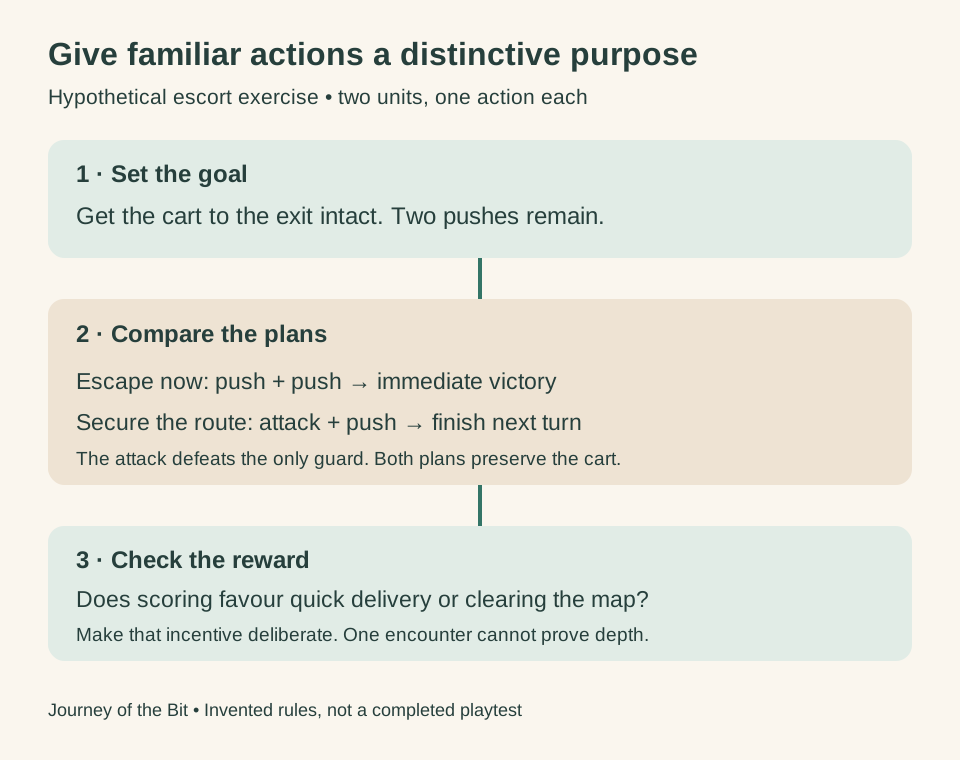
Original hypothetical design exercise, not a screenshot or a tested system. Changing the goal creates a direction; meaningful costs and rewards still need to support it.
Why do rewards need to agree with the objective?
Rewards tell the player which outcomes the game values. If the stated goal and the strongest rewards disagree, the practical strategy may contradict the intended identity.
Suppose the escort version grants its largest bonus for defeating every guard. A player who can safely leave might stay to fight because the scoring system asks them to. That could be an intentional tension, but it would be odd to describe combat avoidance as the central skill without acknowledging the incentive to clear the map.
A different hypothetical scoring rule could prioritise intact delivery, with a smaller bonus for fewer turns. Under those rules, the immediate escape earns more than the slower two-turn plan. This communicates a preference for efficient delivery. It also risks making the answer too obvious if every encounter presents the same safe sprint.
That is the limitation of the exercise: one tiny situation cannot establish a satisfying game. Different maps, obstacles and starting positions would need to create different reasons to delay, protect, divert or advance. Identity should guide the decisions without reducing every mission to the same solution.
How can presentation reinforce the tactical idea?
Make the information needed for the central decision easy to notice. Visual emphasis should help players understand the goal and the cost of their alternatives.
For the invented escort encounter, the cart's condition, remaining route and exposure matter immediately. Those deserve clear cues. An enormous damage celebration paired with a tiny delivery indicator might direct attention towards fighting even when delivery determines success.
This is a proposed design judgement, not a measured result. You would still need to observe whether players understand the display. Our battlefield readability guide explores how occupancy, occlusion and movement previews affect that understanding. Distinctive presentation should make the intended decisions easier to read, not require players to decode unfamiliar symbols simply for novelty's sake.
How can you check whether the identity survives ordinary play?
Test whether people explain their choices using the intended priorities, including in an unremarkable encounter. A dramatic opening scene alone cannot answer that.
A small paper exercise or prototype could support a focused review:
- State the intended experience in one sentence before designing the encounter.
- Record which actions advance the goal and which rewards encourage a competing behaviour.
- Ask a participant to explain their plan without telling them the preferred answer.
- Change one condition, such as route length, and see whether their reasoning changes sensibly.
- Look for a rule that adds work without contributing to the intended decision.
These are suggestions for a future test, not results we have collected. A participant understanding one encounter would show that the example communicates; it would not prove replay value, originality across the whole genre or commercial demand.
We'd rather see a familiar action doing a distinctive job than a new subsystem with no clear purpose. Which tactical game has a goal that changes how you think about every move? Join the studio conversation on Discord to discuss games and game development.