Prioritise battles if you mainly enjoy solving the situation in front of your squad. Prioritise campaign management if choosing what to bring, what to fund and which problems to postpone is part of the appeal. If you enjoy both, look at how one layer changes the other: a busy headquarters screen does not automatically make battlefield decisions more interesting.
The useful question is not which layer is more sophisticated. It is which decisions you want to spend your attention on. A tense fight can be satisfying on its own, or it can become more meaningful because the supplies spent winning it will be missing tomorrow.
What is the difference between a tactical and a campaign decision?
A tactical decision changes the immediate encounter; a campaign decision shapes the resources, opportunities or constraints across encounters. The boundary is useful, even though some choices sit across it.
Choosing where to move a soldier this turn is tactical. Deciding whether to recruit another soldier or improve the equipment of the existing squad is a campaign choice. Selecting a loadout connects the two: it spends or allocates resources before the battle, then determines the tools available inside it.
For a concrete published example, the publisher's XCOM 2 description describes both tactical combat and management of a mobile headquarters. It also describes building rooms and researching or upgrading equipment to affect battlefield capabilities. Those are stated features, not our review of how well they work or a claim about how much time each activity takes.
Our guide to what XCOM-like means explains the broader genre label. Here we are narrowing the question to a preference: do you want the decisions before and after combat to be a major part of the game?
How can the same battle ask a different question in a campaign?
A persistent budget can make a locally useful purchase compete with a future need. The immediate objective stays the same, but the cost of solving it changes.
Imagine an invented two-mission ruleset. You have 100 supply credits and must choose equipment before the first mission. There is no income, resale or loot between missions. Basic equipment is free. A single-use smoke kit costs 40 credits; a workshop upgrade costs 70 and becomes usable only in mission two. You cannot buy both from this budget.
In mission one, a courier begins west of a road and must reach the exit to the east within four turns. A guard watches the crossing. A direct route takes two turns; a sheltered detour takes all four. Under these hypothetical rules, smoke blocks the guard's view of the crossing for the two turns needed by the direct route. The detour needs no smoke, but leaves no spare turn. There are no other enemies or random events in this simplified exercise.
Your two reasonable plans are:
- Buy smoke for 40 credits, take the direct crossing and retain two turns of slack. You have 60 credits left, so the workshop remains unaffordable.
- Buy the workshop for 70 credits and take the sheltered detour with basic equipment. You finish on the deadline, with 30 credits left and the upgrade available next mission.
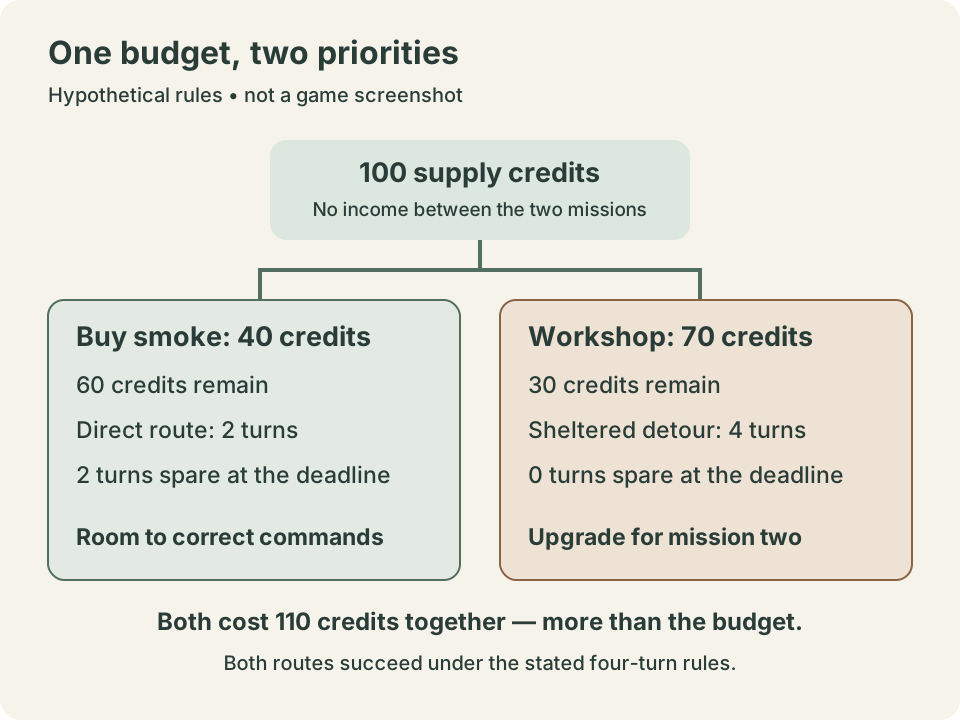
Original hypothetical decision diagram, not a game screenshot. Both routes meet the four-turn deadline under the stated rules; the budget prevents buying both options.
Neither plan is automatically correct. If you value a margin for correcting your own commands, smoke is attractive. If you can execute the detour and value the later upgrade, spending on the workshop is reasonable. We have deliberately left the upgrade's exact benefit unspecified: without the second mission's demands, we cannot calculate an overall winner.
That missing information matters. An attractive campaign choice should give you something to reason about, rather than merely asking you to guess what an unexplained purchase will do.
When does campaign management add something you actually want?
It adds value when preparation and consequences are enjoyable decisions in their own right. Consider whether you would still want to make them if they delayed the next battle.
You might enjoy deciding which specialist to equip, keeping a reserve for an uncertain assignment, or accepting a weaker squad now to improve future options. In our example, the pleasure would be weighing breathing room today against capability tomorrow. Watching the plan pay off is part of the reward.
You might instead find the same choice an interruption. Perhaps you want each encounter to provide a defined set of tools, then challenge you to use them well. That preference does not mean wanting easy combat. A fixed starting position can still support difficult decisions about movement, timing and objectives.
There is also a middle ground: a small number of consequential upgrades may suit you better than several overlapping resource systems. Count meaningful choices, not currencies or menus.
How can you check the balance before choosing a game?
Look at a complete transition from one mission to the next, then identify which decisions you would enjoy repeating. A combat trailer alone cannot show that rhythm.
Use official documentation or clearly identified gameplay footage to check:
- What must be done between missions: purchases, staffing, research, travel or simply selecting the next encounter?
- Which consequences persist, and how clearly are their effects explained?
- Can a poor campaign decision be recovered from, or does it constrain many later battles?
- Are preparation choices varied, or does the footage show the same sequence being repeated?
- Does the evidence cover ordinary play, rather than only an opening tutorial?
Treat anything the evidence does not answer as an open question. Our screenshot-evidence guide helps separate visible features from assumed rules, while the short-session guide addresses saving and interruptions.
Try finishing this sentence: “Between battles, I want to spend my attention on…” If your answer is “the next battle”, that is useful information! If it is “building a plan that lasts several missions”, look closely at the campaign's consequences. Which side of our smoke-versus-workshop choice appeals to you? Join the studio conversation on Discord to discuss games and the decisions that keep you interested.