Start with the developer's website and the documentation for the exact version you are considering, then use gameplay footage and independent accounts to answer questions those sources leave open. Reliability depends on the claim: a feature list can establish what a developer advertises, while a detailed play report can describe one person's experience. Keep the source, date, platform and limits beside each important conclusion.
That sounds fussy until two pages disagree about a feature you care about. One might describe an expansion, another an earlier build, and a third someone's preferred mod. The trick is to find the source that can answer your particular question, rather than collecting more links that repeat the same sentence.
Which official resources are useful first?
Use the developer's overview to establish identity and broad features, then follow its links to the relevant store, manual or support material. Treat the overview as a starting map, not a complete rules reference.
For example, Pathway's official website describes turn-based squad combat using cover and positioning, alongside story encounters. That supports a basic description of the game. It does not establish the exact cover calculation, whether a particular laptop will run it comfortably, or whether you will enjoy its pacing.
Klei's Invisible, Inc. page is useful for another reason: it separates its base-game overview from a section about the Contingency Plan expansion. The expansion section describes a lengthened campaign and additional agents and equipment. Before carrying a feature into your notes, check which product the sentence belongs to.
Official pages have a purpose, too. They introduce and promote the game. We would use them to confirm what is being offered, then seek more specific evidence for questions about difficulty, repetition or comfort. “The developer describes this feature” is a stronger, clearer statement than silently turning promotional language into a verdict.
Where should you look for rules and technical requirements?
Look for maintained manuals, support articles and version-specific documentation when your question concerns a concrete rule or requirement. Read the surrounding conditions, not just the matching phrase.
A useful adjacent example is the OpenXcom repository README. OpenXcom is an open-source recreation of the original X-COM games, rather than a new standalone indie tactics title. Its installation section states that it requires resources from the original games. That detail changes how a reader should understand the project; a short description calling it open source would not answer the installation question by itself.
For any game's documentation, check whether you are reading the released version, a development branch, an expansion or a mod. A repository's current main branch can describe work beyond the build someone has installed. A manual can also lag behind a patch. When a detail matters, match the document to the version instead of assuming the newest-looking page applies everywhere.
For hardware questions, start with the requirements for your platform and edition, then look for evidence from comparable hardware. Our old-laptop guide explains why visual style alone cannot settle performance.
How can you turn a vague claim into something checkable?
Rewrite the claim as a specific question, then record what would count as an answer. A small evidence note can prevent an appealing phrase from becoming an unsupported assumption.
Imagine an invented game whose store description says “flexible saving”. You want to know whether you can stop halfway through a mission. The following is a hypothetical research exercise, not a claim about any linked game:
- Write the question: “Can I save during a mission, close the game and resume that position?”
- Look for a manual or support explanation covering mid-mission saving, including any mode restrictions.
- Check footage or a suitable demo for the actual save, exit and resume sequence.
- Record the build, platform and mode alongside the result.
- Leave any untested condition open, such as whether the same behaviour applies in a challenge mode.
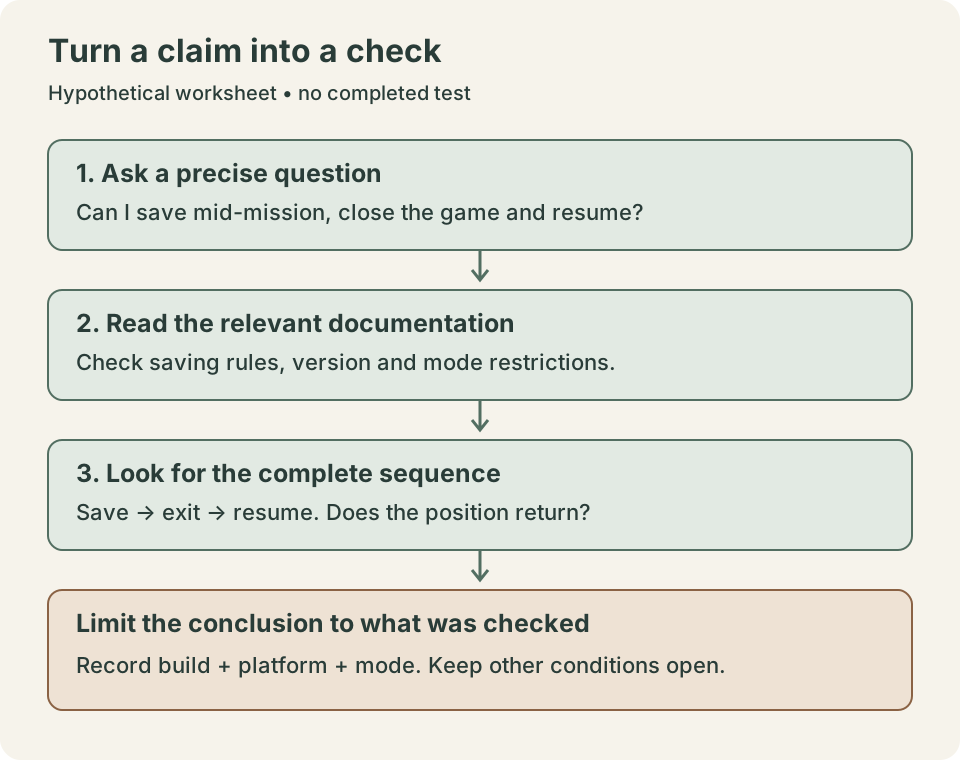
Original hypothetical research worksheet. It illustrates how to check one claim; it reports no completed test and describes no real game's saving behaviour.
A screenshot of a save button is a useful lead, but it does not establish that the saved position survives quitting. Our screenshot-evidence guide covers that narrower problem. Here, the aim is to connect different sources without asking any one of them to prove more than it shows.
How should you use reviews, videos and community answers?
Use them for specific observations and experience, while checking the context behind each account. Someone explaining why an encounter frustrated them is more informative than a bare “too hard”.
Look for the version, difficulty, platform and amount of play covered. For videos, distinguish an edited highlight from a continuous sequence. For reviews, note whether the writer explains access arrangements or sponsorship and whether their preferences resemble yours. Disclosure helps you interpret an account; it does not automatically make the conclusion right or wrong.
Community answers can point you towards an overlooked setting or a useful source. Follow that lead back to documentation or observable behaviour when possible. Several posts repeating one unsourced answer are still one unsupported claim. If two accounts conflict, first check whether they describe the same build and mode before deciding that one author is mistaken.
When do you have enough information to decide?
Stop when your important questions have suitably specific answers, and make the remaining uncertainty explicit. You do not need a complete encyclopaedia to decide whether a game is worth investigating further.
Keep three short notes: what is confirmed, what is someone's reported experience, and what remains unknown. Choose the next source according to the unknown that matters most. If your concern is the time spent between missions, our battles and campaign management guide helps frame that question.
Which detail do you always check before trying a tactics game? Join the studio conversation on Discord to discuss games, useful resources and the questions a feature list leaves unanswered.