Ask what interests you now, what is actually demonstrated, and what future evidence would make you reconsider. Keep following news separate from buying access or volunteering to test: each asks for a different commitment. You can be enthusiastic about an idea while leaving its release date, final features and suitability for you unresolved.
An announcement does not need to answer everything to be worth watching. Perhaps the appeal is a distinctive art direction, a clever tactical rule or an interesting design explanation. The useful habit is to name that appeal precisely, so your expectations do not quietly grow beyond what has been shown.
What are you hoping to get from following the game?
Decide whether you want occasional news, an opportunity to try a build, or detailed discussion of development. Those interests can lead to different choices about how closely to follow.
If you only want to know when a playable version becomes available, a low-attention bookmark or an appropriate announcement channel may be enough. If you enjoy reading design notes, the explanation itself can be worthwhile even while the eventual game remains uncertain. Neither requires treating every update as a verdict on the whole project.
Write one sentence: “I am interested because…” Then check whether it names something visible or something you have imagined. “I like the movement decisions shown in this clip” is specific. “This will be the enormous campaign I have always wanted” contains several assumptions unless the evidence supports them.
Our guide to interpreting gameplay screenshots helps with visible evidence. The question here goes further: how much attention do you want to commit while important details are still open?
Which features exist now, and which are plans?
Separate demonstrated behaviour, stated intentions and unanswered questions. A roadmap describes a direction; it does not give you the same evidence as using a feature in a playable build.
Valve makes a related distinction in its Steam Early Access guidance: customers should evaluate the current game rather than depend on future additions, and developers should not make specific promises about uncertain future events. That guidance concerns Steam Early Access purchases. Our broader editorial suggestion is to apply the same care to expectations before any purchase is involved.
This is not a reason to dismiss plans. A proposed feature can be exactly why you are interested. Simply keep the wording honest: “I would like to see this” is different from “this is available”. Check whether an update reports a working change, announces a goal or asks for opinions on an unresolved choice.
If a feature is essential to you, make it a question to revisit. Controller support, readable text, saving during missions and a particular platform are all things to check explicitly. Silence on a requirement leaves it unknown; it does not confirm either inclusion or exclusion.
How can you set a useful checkpoint without predicting a release?
Choose an observable event that would answer your biggest question. You do not need to guess when development will finish to decide when to look again.
Imagine an invented tactical game announcement with a short combat clip, a planned campaign mode and no stated text-scaling options. A reader likes the positional combat but needs larger interface text. Their notes could look like this:
- Interesting now: the clip shows a unit choosing between two routes around cover.
- Still uncertain: whether that choice remains interesting across a full mission, and whether interface text can be enlarged.
- Planned: a campaign connecting missions, with no playable campaign evidence supplied.
- Next checkpoint: footage of the settings and an ordinary mission, or a suitable playable build.
- Current decision: keep an occasional eye on updates; leave testing or purchasing decisions until the relevant evidence appears.
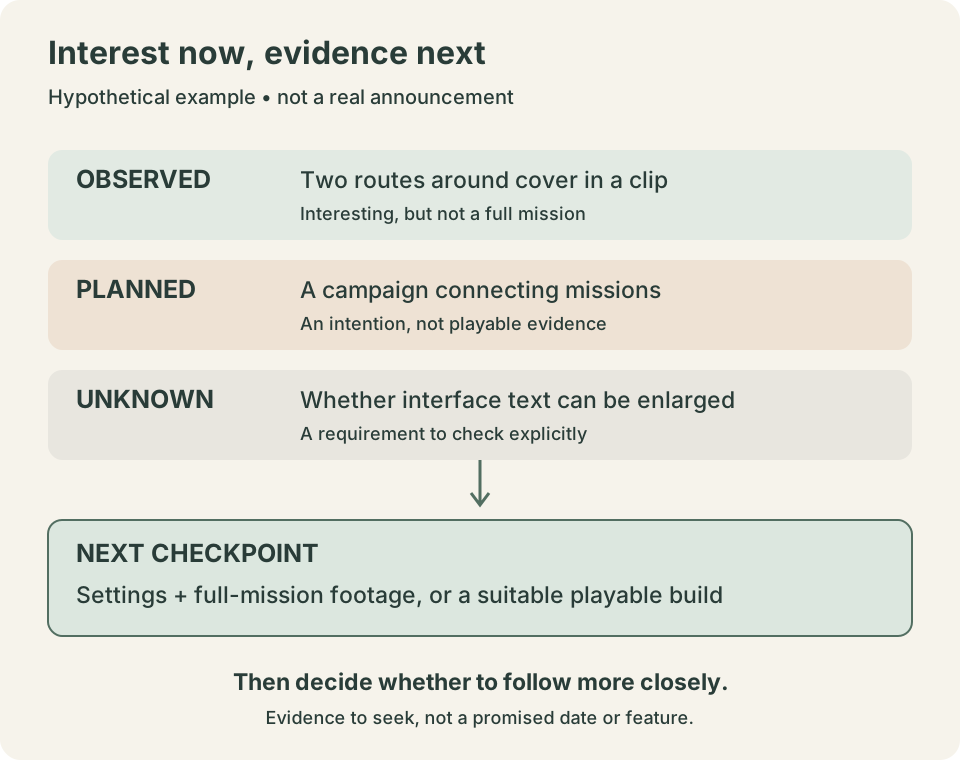
Original hypothetical planning diagram. It describes no real announcement, completed test or studio project; the checkpoint is evidence to seek, not a promised milestone.
Another reader might enjoy following the design discussion regardless of the eventual accessibility options. That is also reasonable. The exercise is about matching involvement to your needs, not producing a universal score for whether a project deserves attention.
Does a playtest invitation mean you can play whenever you like?
Check the access conditions and testing window before setting aside time. An invitation to request access is not necessarily immediate admission, and a test is not necessarily permanent access.
The Steam Playtest documentation describes both limited signups, where developers admit players in batches, and open signups. It also explains that a playtest can be deactivated, after which Steam will not launch that test app. Steam Playtest access is free; those details apply to that particular system, rather than every programme described informally as a beta.
For any test, look for its purpose, available content, supported setup and how feedback should be submitted. Check whether progress is expected to carry forward instead of assuming it will. A narrowly scoped test may be useful for evaluating controls while telling you little about campaign balance or long-term variety.
If you do participate, distinguish a reported problem from a feature request. Our useful-feedback guide explains how to describe the situation and result without pretending your preference represents everyone.
What should make you change how closely you follow?
Revisit your original reason for interest when new evidence arrives. Increase, reduce or pause your attention according to what you learn, rather than how long you have already been following.
A clear update might answer the question that mattered to you. It might also reveal that the game's direction is different from what you hoped. A quiet period alone does not explain its cause, and frequent posts alone do not establish the quality or completeness of a build. Look for information relevant to your checkpoint.
Keep the next step proportionate: read an update, inspect new footage, or try an available build if it suits your needs. Our reliable-information guide covers checking sources and versions when accounts disagree.
What evidence makes an unreleased game worth your ongoing attention? Join the studio conversation on Discord to discuss games, expectations and the questions you like answered before getting more involved.