Start with the objective, the controls and one small decision you can explain before committing. Use the tutorial or a manageable opening encounter to learn what an action costs and what changes after it, then add another rule once that connection is clear. You do not need to understand every class, upgrade and campaign system before your first useful turn.
A first battle can put a lot on screen: portraits, coloured tiles, unfamiliar symbols and a button that seems to end everything. We would begin by shrinking the question. Instead of “How do I win this whole game?”, ask “What can this unit do, and how will I know whether the command worked?”
What should you check before making your first move?
Find the mission objective, identify the selected unit and learn how to inspect an action without accidentally confirming it. Then check the controls and settings that let you read and operate the interface comfortably.
Look for text size, camera controls, input bindings and any available explanation of the selection and confirmation process. Do not assume a click merely previews a move, or that a second click is always required. Use the game's own instructions to establish that distinction.
The Game Accessibility Guidelines on remappable controls explain why configurable inputs help people with different needs, preferences and hardware layouts. For a beginner, our practical application is to check the available options early, rather than treating an awkward default as something you must master. This does not mean every game offers the same settings.
Read the objective literally. Reaching an exit, protecting an object and defeating every opponent are different tasks. If an objective label is unclear, inspect its description before building a plan around an assumption.
Should you use the tutorial or work things out yourself?
Use guided practice when it is available and helpful, then test your understanding in a small situation. Reading a rule and using it are different parts of learning.
The Game Accessibility Guidelines on interactive tutorials recommend pairing instruction with interaction and discuss the value of practising within gameplay. That is design guidance, not proof that a particular tutorial will suit everyone. Our suggested player habit is to pause after a lesson and explain the action in your own words.
For example: “This command spends one action and changes my position.” If you cannot yet say what was spent, check the display or tooltip again. A tutorial may temporarily restrict options or use special conditions, so avoid assuming every rule demonstrated there applies unchanged in ordinary missions.
If there is no tutorial, look for an introductory scenario or a small encounter with a straightforward objective. Keep a manual nearby for the question you are currently answering. You can leave advanced build guides until you know which basic choices they are trying to improve.
What can you learn from a deliberately simple encounter?
You can learn to connect a command, its cost and its visible result without also solving targeting, cover and probability. Start with a situation where the rules are explicit.
Imagine this invented training exercise. A unit starts on tile A of a straight four-tile lane: A, B, C, D. Tile D is the exit. The unit has two action points per turn, and each move to the next tile costs one point. Points refresh to two when a new turn begins; unused points do not carry over. There are no enemies, obstacles, diagonal moves or automatic reactions. Reaching D completes the exercise immediately.
Before the first command, predict the result: moving from A to B should leave one action point. Make that move, then check both the unit's location and the remaining budget. If the display matches, you have confirmed one simple relationship under these invented rules.
Move from B to C with the remaining point. The unit should now have zero. Begin the next turn, check that the budget returns to two, and move from C to D. The exercise finishes with one point unspent. Spending every available point was never the objective.
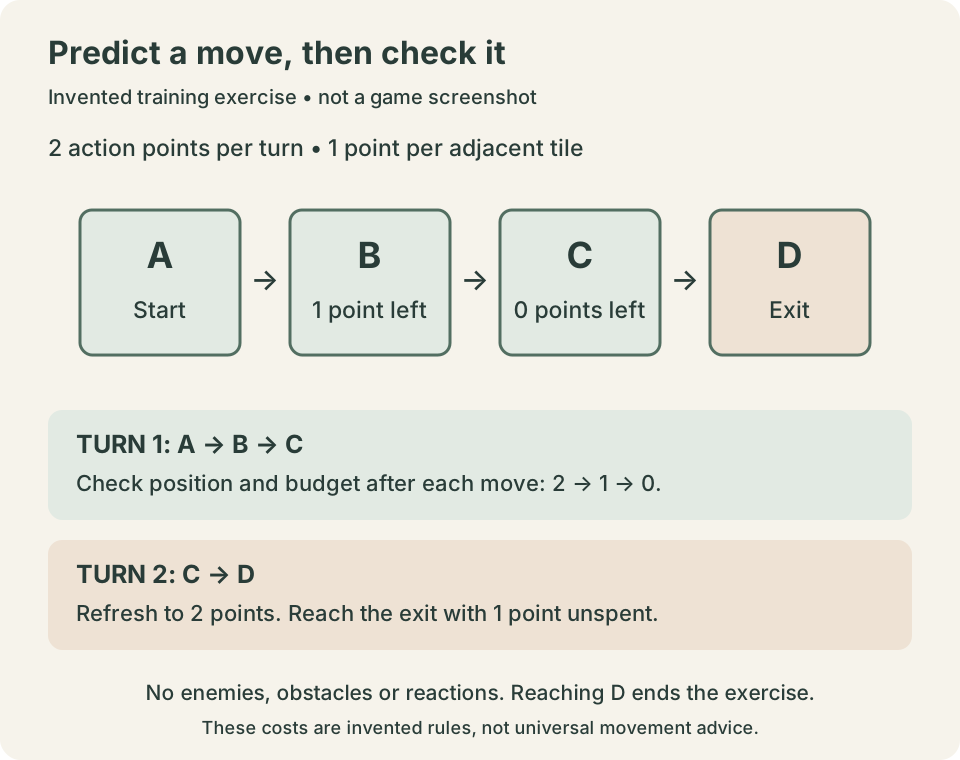
Original hypothetical teaching diagram, not a game screenshot. The lane uses the explicit rules in the text; real games may price movement differently or allow other units to react.
This exercise is intentionally too simple to establish good combat tactics. Its purpose is to practise predicting a cost and checking the result. Once that is comfortable, add one complication, such as a tile with a different movement cost, and ask what changes. Our action-points and time-units guide explains why budgets should not be assumed interchangeable between games.
What should you do when an action surprises you?
Separate a misunderstanding of the controls from a misunderstanding of the rules, then investigate the smallest unanswered question. A surprising result does not always mean the whole plan was bad.
Ask yourself:
- Did I select the intended unit and destination?
- Did the preview describe a cost, a possible result or a guaranteed result?
- Did a status effect or action-specific rule change what was available?
- Did another unit act in response?
- Was the result uncertain even though the command was valid?
Use tooltips, an event log or the relevant manual section if the game provides them. If you replay a suitable practice situation, change one choice at a time so you can explain the difference. Do not assume that undo, reloading or repeated attempts will preserve exactly the same conditions.
Our visibility and targeting guide covers one common rules distinction: seeing a target and having a valid shot need not be the same thing. Keep that sort of question separate from whether you pressed the correct control.
How do you know when to add more complexity?
Add another rule when you can predict and explain the basic action you are practising. Winning is useful feedback, but understanding why a command worked is a better checkpoint for this learning exercise.
Try a short recap after the encounter: what was the objective, what did your chosen action cost, and what changed afterwards? Keep one unresolved question for the next session. You can then explore positioning, squad roles or equipment without trying to learn them all at once.
Which rule took you a while to understand in your first tactics game? Join the studio conversation on Discord to discuss games and the explanations that made their decisions click.